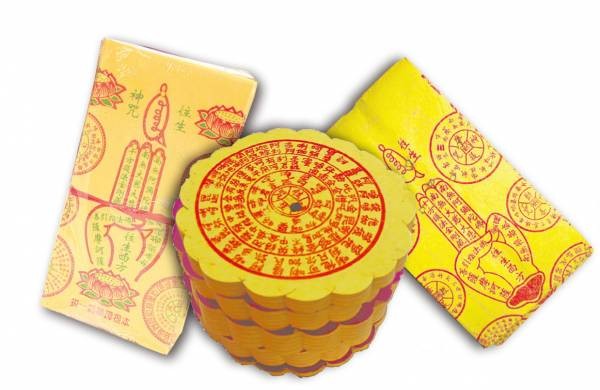
The practice of burning mantra paper money (往生纸//往生钱) to benefit the deceased is a Chinese folk culture that is contrary to Buddhism. Such a practice creates bad karma for both the living and the dead. The main issue being discussed here, is the burning of paper with printed Buddhist mantra.
Background.
According to Chinese folk beliefs, a person becomes a spirit or ghost after death and they live in the nether realm. There are ghost cities and towns with their ghost Kings and magistrates. Ancestors need to be remembered and honoured, just like how we practice filial piety towards our living parents.
Paper money is an invention that emerged after the invention of paper. That is logical right? This implies that ancient people have no issue with not burning paper money prior to the invention of paper?
According to the historical record of folk culture in China, the practice of burning paper money did not arise immediately after the invention of paper. Like many cultures around the world, real money was buried along with the dead. That is limited to the affluent people because the poor cannot afford to bury real money right? The practice of burying paper money with the dead started much later. Paper money is a mock representation of real money and it reflects the imagination of the needs in the afterlife.
Please note that until here, these beliefs are Chinese folk beliefs and has nothing to do with Buddhism. Furthermore, there was no burning of paper money yet. The poor folks in ancient China, bury fake paper money with the dead.
The burning of paper money probably developed after foreign religion, such as Buddhism was introduced into China. Some of these foreign cultures believe that fire is a medium or “spiritual portal” that enables objects of our physical world to be delivered to the spiritual world.
From the above, we should understand that burning paper money is a Chinese cultural practice that was invented by man and developed over a period of time through the influence of non-chinese culture.
Mystical Stories
Many Chinese ghost stories tell of deceased family or friends appearing in the dream of their living kins, asking for money or necessities of life. These haunting dreams only stop when the living person satisfy the demand of the dead by burning paper money, clothing, houses and even paper servants!
It is interesting to note that the ancestors of non-Chinese do not have such needs?
There are also stories of exorcism or appeasement ritual that were performed with the burning of paper money. How does it work?
If we consider my previous articles on the 36 types of ghost, perhaps the spirits were craving for smoke and mental associations instead. In that context, it is the smoking that is desired by these ghosts and definitely, not the shape of the paper offerings.
Burning of paper mantra

Here is where this cultural practice becomes enmeshed with some Mahayana Buddhist ideas. Typically, the mantra for rebirth in the Pureland of Amitabha Buddha is printed on paper. These papers are touted as “currency” that guarantee a safe passage to Amitabha’s Paradise.
Such mistaken beliefs arises because people are ignorant of Buddhism but hope that their loved ones enjoy the same benefits of practising Buddhist!
For a start, you cannot buy your way to heaven! It is an insult to Buddha if you believe He needs those paper money from you to sell you a lotus seat in the Pureland. To be reborn in the Pureland, one needs to have good karma and practice well.
The practice requires recitation and concentration. Burning 1000 pieces of mantra paper does not equal to 1000 concentrated recitation! You are only killing more trees and haring more living beings in the forest.
When one burns sutra or verses of sutra or mantra, it is an act of destroying Dharma. Sutra and mantra is a tool for practising Buddhist mind training. Burning them deprives others of an opportunity to read and practice. It also spread ignorance and promote unskillful actions. Bad karma!
The act of burning Dharma-related objects and rejoicing in that action, creates ignorance in one’s mind. That leads to more ignorance and that mental habit will carry over to one’s future rebirth. It is a karma that leads to future downfall (spiritual evolution)
Therefore, such a practise should be discouraged. While it is improper for us to comment on the cultural practice of Chinese, it is important to correct a misunderstanding about Buddhism.
May all be well and happy.
Categories: Articles
 I am just an ordinary guy in Singapore with a passion for Buddhism and I hope to share this passion with the community out there, across the world.


 Bodhi-Bowl
Reading your post, I found myself reflecting on my own contrasting experiences.
Under the guidance of enlightened Buddhist practitioners (High Monks), I’ve experienced the positive effects of burning mantra paper during Homa after the rituals to guide the deceased to transcendence, including practices like the Liberation Rite of Water and Land etc.
The Liberation Rite of Water and Land, as described, demonstrates a profound understanding of the interconnectedness of all beings, and the intent to liberate all sentient beings from suffering. This includes beings of the six realms, both enlightened and unenlightened, those dwelling on land, in water, and even in air. The ritual entails manifold offerings to beings across these realms, embodying compassion and generosity.
In my experience, these practices, including the burning of mantra paper, have fostered positive karma for both the living and the deceased, rather than creating bad karma as you’ve suggested.
In Buddhist philosophy, no practice is one-dimensional, and burning paper mantras is no exception. It’s not just a simple physical act, but an expression of compassion, a means of creating positive karmic ties, and so much more. Viewing these practices without fully understanding their cultural, historical, and religious contexts can lead to misinterpretations.
Moreover, it’s crucial to grasp the essence of the Buddhist worldview – the cyclical existence in the six realms of Samsara, which includes the ghost realm. In this perspective, there is no inherent good or bad, only cause and effect – a principle that transcends human dualistic thinking.
The broad tapestry of Buddhism is filled with diverse practices, each woven with unique cultural threads. Making absolute judgments without fully comprehending these complexities can result in a narrow perspective and can potentially generate negative karma through spreading misinformation.
In the spirit of fostering deeper understanding and respectful dialogue, I would encourage you to delve deeper into these rituals. Maybe engage in discussions with practitioners who have discovered meaning and value in them. I truly believe this will enrich your reflections on Buddhist practices and help ensure accurate representation in your writings. Remember, the essence of Buddhism is not just in its teachings but also in its practices and rituals, as they offer a tangible way to internalize and embody the teachings.
Best wishes on your path,
MY
LikeLike
Thank You MY for your compassion and concern for me.
I respect your good experience in your spiritual practices and your admiration for your masters.
Nonetheless, I still believe and respect what my master taught as well.
Buddhism consists of many diverse paths, each of them leading to Enlightenment and Happiness. Each of them suitable for a diverse spectrum of people.
I am happy that you found your happiness and celebrate that your path brings you there.
You obviously know what you are sharing. My article is meant for beginners like myself. So I will still advise people who are not trained in rituals to abstain from burning mantra paper superstitiously.
One of my personal favourite story is about Master GuangQin burning mantra paper to liberate some spirits. Observers noted that the master was chanting and burning the paper piece by piece with much mindfulness and solemness. Colored sparks flew out from the ordinary burning paper that was purchased from the market (No trickery). It sounded very inspiring to me.
Along the line of this story, my master would advise me not to compare myself with Master Guangqin. It is better for me to practice compassion by chanting mantra or the Buddha’s name. No Burning of Dharma. (That is my path)
Once again, thanks for your compassion. I think it takes a lot of confidence to walk your Dharma path. I wish you well.
LikeLike
People burn the mantra papers because they are trying to help relieve some of the karma from the wandering ghost. It is not to buy their way into heaven. I agree that burning the mantra paper does not equal the amount of mantra you have recited.
LikeLike
Thank you for sharing your views. In some places, they call mantra paper, money for transmigration and even print picture of an ancient coin on the paper. I was told none of the Buddhist sutra taught that. The general Mahayana scripture constantly encourage people to print and copy Buddha’s words and spread it. None taught about burning it. I guess that’s why there was such a conclusion from one of the monks that I follow.
LikeLike