
The Story of Ven. Anuruddha
Prince Anuruddha was one of the six princes who traveled to the Anupiya Mango Grove to seek ordination from the Buddha. He was born with an immense store of merit accumulated from a previous life.
From Pauper to Prince
In that former life, Anuruddha was a pauper who once offered food to a Pacceka Buddha named Upariṭṭha. Due to the power of that merit, he was later reborn into a royal family with doting parents. Even the heavenly devas favored him, constantly endeavoring to make his every wish come true. Consequently, he lived a pampered, entirely carefree life.
The Decision to Ordain
When his family was asked to provide a son for the Sangha, Anuruddha was initially hesitant. However, his perspective shifted once he learned about the responsibilities of a householder. He realized that the effort required to maintain those duties was far more complicated and exhausting than he had imagined.
As we can see, he originally entered the monkhood out of a sense of obligation and the belief that a monk’s livelihood would be more relaxed.
Mastery of Divine Sight
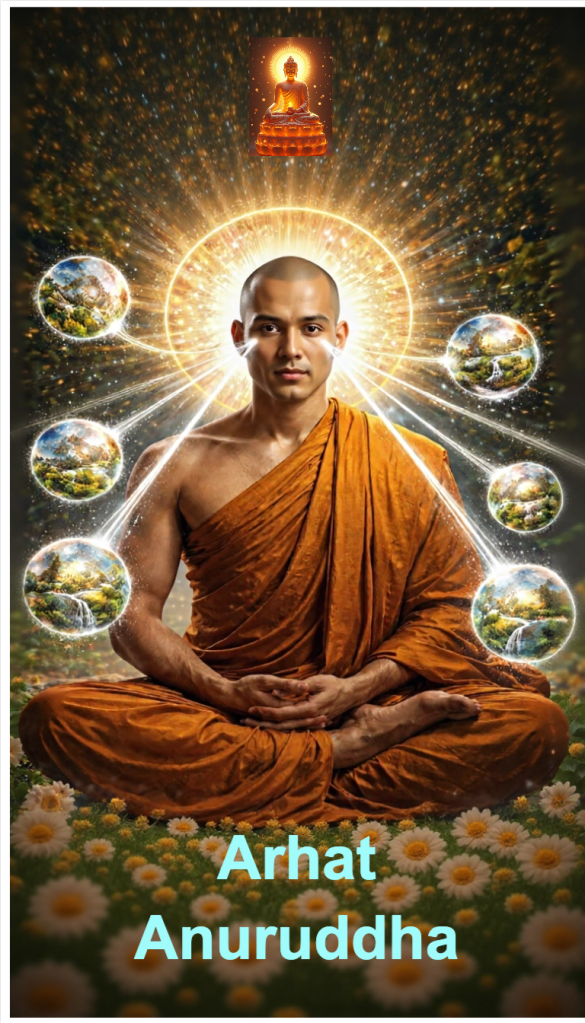
Nonetheless, Ven. Anuruddha achieved the eight mundane meditative attainments (jhāna-samāpatti) during his very first Rains Retreat. Building upon these, he developed Divine Sight (dibba-cakkhu-abhiññā), a supernatural power that enabled him to see 1,000 world-elements. He eventually became known as the Arhat foremost in this ability.
The Path to Enlightenment
It is important to note that after acquiring Divine Sight, Anuruddha was not yet enlightened. This highlights a crucial point: acquiring divine capabilities is distinct from achieving Nirvana or wisdom. (Note: Since supernatural powers are not the best indicator for a person’s wisdom, we should not believe blindly in anyone simply because they appear to possess supernatural powers)
Well aware that he had not yet reached full enlightenment, Ven. Anuruddha consulted Arhat Sariputta. Their conversation, which follows, serves as a vital reference for those aiming for Nirvana in their own practice.
| What Anuruddha said: | Sariputta’s reply: |
| One day, he went to Ven. Sāriputta and told him (AN 3.130): 1. “Friend Sāriputta, in this Buddha’s Dispensation (sāsana), I can see the 1,000 world-elements by means of divine sight (dibba-cakkhu-abhiññā). | “Friend Anuruddha, 1) when you are preoccupied with the thought as described in your first statement, it is a case of pride (māna) arising in your mental continuum; |
| 2. My effort is vigorous and resolute, not flagging. My mindfulness is clear and intent, wholly free from forgetfulness; my body is also calm and collected, completely free from anxiety; my mind is serene, fixed on a single object. | 2) regarding the preoccupation described in your second statement, it is a case of distraction (uddhacca) arising in your mental continuum; |
| 3. In spite of all this, my mind, though void of craving (taṇhā) and wrong view (diṭṭhi), is still not free from the grip of the pollutants (āsava).” (Unawakened State of mind) | 3) as regards your third statement, it means that you are being assailed by worrying over past commissions and omissions (kukucca). |
The conversation between the 2 offers great insight into our own thoughts as practitioners. It deserves careful contemplation to gain wisdom for our practices.
The Final Path to Arhatship
Despite receiving meditation guidance from Arhat Sariputta and practicing diligently, Ven. Anuruddha initially found that his progress remained limited. Seeing this, the Buddha personally intervened and provided him with two profound teachings:
- The Discourse on Anuruddha’s Great Thoughts ($Anuruddha-mahā-vitakka-sutta, AN 8.30$)
- The Discourse on the Lineage of the Noble Ones ($Ariya-vaṁsa-sutta, AN 4.28$)
Following the Buddha’s specific instructions, Ven. Anuruddha spent the next two Rains Retreats ($Vassa$) at the Bamboo Grove. Through unwavering commitment to his meditation practice, he eventually transcended all mental fermentations and attained the stage of Arhat.
We shall explore these 2 sutta separately in another post.
May all be well and happy.
Discussion
1. Merit vs. Liberation
Anuruddha was born into royalty because of a single act of generosity in a past life as a pauper.
- Discussion: How does this story change our perspective on “small” acts of kindness?
- Deep Dive: Anuruddha had “divine sight” but was not yet enlightened. Why are psychic powers considered “mundane” rather than “supramundane” ?
2. Motivation for Ordination
Anuruddha initially joined the Sangha because he found householder life “exhausting and complicated,” not necessarily out of a deep spiritual yearning.
- Discussion: Is it “wrong” to seek a spiritual life just to escape worldly stress?
- Reflection: How does his story show that even a “casual” start can lead to the highest goal if one eventually applies diligent effort?
Feel free to discuss and share your thoughts in the comments.
Categories: Articles, Shakyamuni Buddha
 I am just an ordinary guy in Singapore with a passion for Buddhism and I hope to share this passion with the community out there, across the world.


 Bodhi-Bowl