
They say imitation is the best form of flattery.
My first encounter with Tibetan Buddhism left me deeply puzzled.
My background was shaped by Chinese and Thai Buddhist environments, where monks were generally quiet, understated, and visibly simple in their lifestyle. Humility was something you could feel in the air.
Then I walked into a Tibetan Buddhist setting.
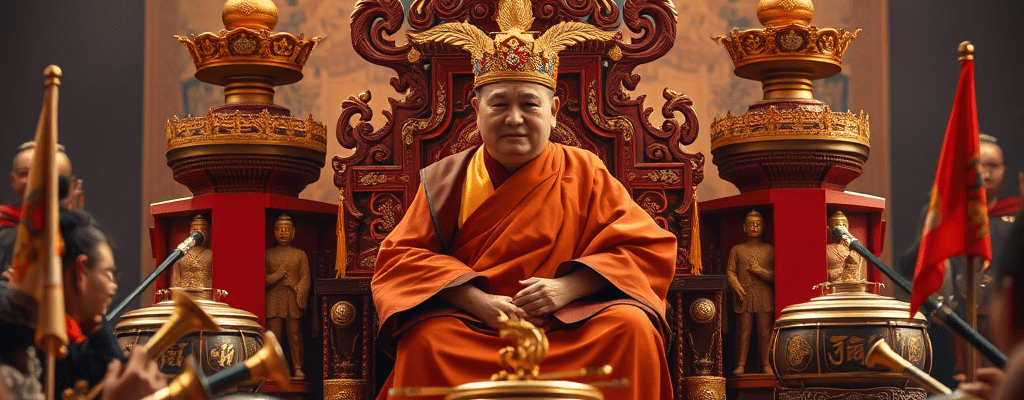
The leading lama sat on a throne. His arrival was announced with trumpets, drums, and ceremonial music. There was pageantry, procession, and an unmistakable sense that someone extremely important had arrived.
It felt… theatrical.
Part of me couldn’t help wondering:
Didn’t the precepts discourage sitting on high seats?
Didn’t monks vow simplicity?
At first, I was quietly uncomfortable.
But discomfort, when mixed with curiosity, slowly turns into adaptation.
Assimilation into a New Culture
As I spent more time around Tibetan Buddhism, the shock softened.
Large ceremonial hats no longer looked strange.
Thrones became normal.
Ritual instruments, elaborate iconography, and complex liturgies began to feel natural.
Whenever doubts arose, I was told:
“All of this is for the benefit of sentient beings.”
“Our methods are superior.”
“This is the fastest path to enlightenment.”
And I believed it.
Not maliciously.
Not critically.
Simply sincerely.
Looking back, I realize something subtle was happening.
I wasn’t just learning a tradition.
I was absorbing an identity.
The Little Boy in a Red Cape
Over time, I began to imitate Tibetan monks.
Not consciously.
More like how a young boy puts on a red cape and runs around shouting, “I’m Superman!”
We smile at children who pretend to be superheroes.
But it becomes a different matter when adults start wearing spiritual costumes without realizing it.
I adopted mannerisms.
I carried myself differently.
I wore prayer beads made of bone.
To people unfamiliar with Tibetan culture, I must have looked… odd.
Possibly creepy.
But when people reacted cautiously, I didn’t think:
“Maybe I look strange.”
Instead I thought:
“They must sense my spiritual depth.”
“They’re probably intimidated by my knowledge of ghosts, spells, and rituals.”
Yes.
That was my ego talking.
A Small Tease, A Big Wake-Up Call
One day, I visited a Chinese Buddhist center.
An elderly practitioner looked at me, chuckled, and said:
“Oh! You walk just like those old lamas.”
I was in my early thirties.
I went home feeling oddly proud.
“I’m Vajrayana,” I told people.
As if that sentence alone elevated me.
Deep inside, all those teachings about Vajrayana being the “highest” and “fastest” path had quietly placed my ego on a throne of its own.
That comment, innocent as it was, planted a seed.
It made me realize something uncomfortable:
How I experience myself
is not how others experience me.
I thought I was embodying depth.
Others saw a young man role-playing an exotic identity.
I had drifted into fantasy.
When Devotion Turns into Performance
I’m sharing this because I now see people doing what I once did.
Playing lama.
Playing ajahn.
Playing holy person.
Not inside temples.
But in public spaces, social gatherings, and daily life.
For most people, religious symbols and stories from unfamiliar traditions mean nothing.
At best, they look mysterious.
More often, they look bizarre.
Sometimes we think we are projecting sacredness.
In reality, we are projecting confusion.
And instead of inspiring faith, we create distance.
The Quiet Danger
The danger is not in loving a tradition.
The danger is in confusing external form with inner transformation.
You can wear robes and remain unkind.
You can chant in Sanskrit and still be arrogant.
You can memorize rituals and still be lost in ego.
Meanwhile, someone in jeans who practices patience, honesty, and compassion may be far closer to the heart of Dharma.
That realization stings.
But it is also liberating.
What I Learned
True practice doesn’t need costumes.
It doesn’t need to announce itself.
It doesn’t need to look impressive.
If your practice is real, it will show up as:
• Softer speech
• Less reactivity
• More humility
• Greater kindness
Not as a spiritual aesthetic.
Closing Reflection
Imitation can indeed be flattery.
But eventually, we must outgrow imitation and become genuine.
Otherwise, we risk turning Buddhism into cosplay.
And ourselves into weird Buddhists.
Not because the Dharma is strange—
but because we forgot that the real work happens quietly, inside.
May all be well and happy.
Categories: Articles
 I am just an ordinary guy in Singapore with a passion for Buddhism and I hope to share this passion with the community out there, across the world.


 Bodhi-Bowl
Okay, this has to be one of my favorite posts by you. Although I have to admit that the bone prayer beads and knowledge of spells and ghosts is kind of awesome. Not to be used as pageantry but as knowledge to help. But I agree. You have grown much and I hope you continue grow.
LikeLiked by 1 person
Thank you 🙏😊
LikeLiked by 1 person
🙏 🪷☸️
LikeLike
I feel the adaptation too.
LikeLiked by 2 people
Adaptation helps us to dive deep. But Personally, I benefited from not losing sight of the Theravada Pali canon.
LikeLike