
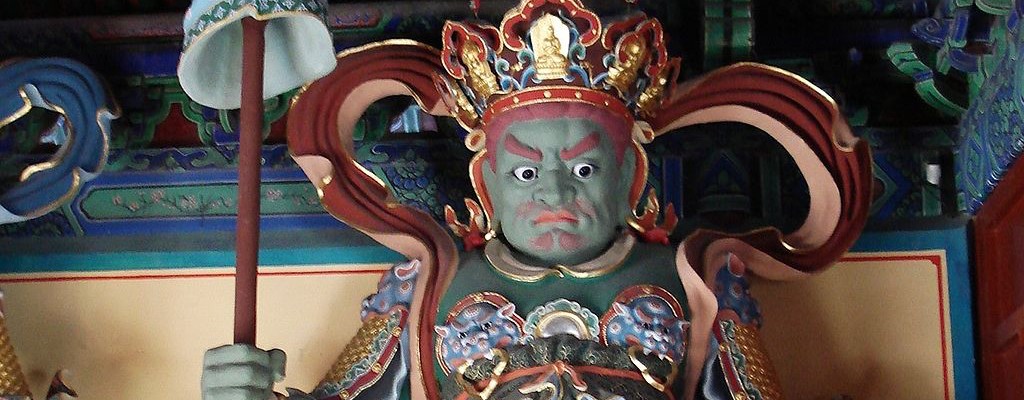
So I have heard. At one time the Buddha was staying near Rājagaha, on the Vulture’s Peak Mountain. Then, late at night, the Four Great Kings—with large armies of Yaksha, Gandharva, kumbhāṇḍa, and Naga—set guards, troops, and wards at the four quarters and then, lighting up the entire Vulture’s Peak with their beauty, went up to the Buddha, bowed, and sat down to one side. Before sitting down to one side, some spirits bowed, some exchanged greetings and polite conversation, some held up their joined palms toward the Buddha, some announced their name and clan, while some kept silent.
https://suttacentral.net/dn32/en/sujato?layout=plain&reference=none¬es=asterisk&highlight=false&script=latin
Continuing with our study of the spirits, we start with the class of spirits known as Yaksha. Yaksha’s are understood to be powerful supernatural beings that is associated with nature (more appropriately, natural landmarks). For example, hills, mountains, caves, large trees, forests, jungles, etc. Therefore they are terrestrial spirits.
They are territorial and some wandering monks who seek secluded places for their meditation retreats had recounted strange dreams or visions concerning this class of spirits. Yaksha can appear malevolent or benevolent, depending on their intentions. Typically, a malevolent Yaksha is known to cause illnesses, nightmares, and even accidents to those who offended them.
In the Alavaka Sutta, a Yaksha was able to attain Sotapanna enlightenment and thereafter vowed to protect Buddhism. From this perspective, Yakshas are not spirits that are eternally evil but capable of reasoning, being educated, and positive transformation. Just like any beings in Samsara, they are afflicted by greed, hatred, and ignorance.
In another Buddhist story, a passing Yaksha decided to club Sariputra because he simply wanted to see if there is anything great about a meditating Arhat (fully enlightened disciples of Buddha). Sariputra who did not possess any supernatural ability was oblivious to that unprovoked violence but Mogallana, who was foremost in supernatural ability, was alarmed. He rushed to Sariputra to enquire if everything was fine with him and Sariputra shared that he experienced a slight headache. In this case, we see a Yaksha behaving like a street thug who simply wanted to “prove” himself.
Yaksha is depicted as demonic-looking beings with fangs and holding clubs. As mentioned, not all Yakshas are evil, some are benevolent and are Buddhist protectors. We typically find images of Yaksha placed outside Buddhist temples. This is meant to reflect their status as guardians of Buddhism.
In Buddhism, we do not view such spiritual entities as representing evil and requiring immediate exorcism. If a person offended a Yaksha due to unintentional trespassing of their territory, a “simple” apology might be all that is needed to recover from haunting and possession.
Having said that, nor do we intentionally reach out to them or try to associate with them.

May all be well and happy.
Categories: Articles
 I am just an ordinary guy in Singapore with a passion for Buddhism and I hope to share this passion with the community out there, across the world.


 Bodhi-Bowl
Out of curiosity, why do Buddhists not go out of their way to know the spirits or their ways? Is it out of caution or a belief or teaching?
LikeLike
Thank you for asking. The following are not in any order.
Being Caution:
When we say spirits, we are referring to terrestrial spirits and not heavenly beings. Although heavenly beings are moral, we also do not reach out to them because we believe that the terrestrial spirits will try to pass off themselves as heavenly beings to beguile us.
Most spirits are not inclined to Buddhist practices and they will try to influence us to be like them. It is like us trying our best to avoid associating with people of bad character. Therefore, it is out of caution that we try not to associate with spirits.
quoting from this sutta: “Seated to one side, the Great King Vessavaṇa said to the Buddha, “Sir, some high spirits have confidence in the Buddha, some do not. Some middling spirits have confidence in the Buddha, some do not. Some low spirits have confidence in the Buddha, some do not. But mostly the spirits don’t have confidence in the Buddha. Why is that? Because the Buddha teaches them to refrain from killing living creatures, stealing, lying, sexual misconduct, and drinking alcohol. But mostly they don’t refrain from such things. They don’t like that or approve of it.”
From this verse, we understand that most spirits do not align with Buddhist practices.
In SE Asia, we see many spirit mediums and shamans because people believe in them. In a typical ritual, we usually witness the possessed medium slaughtering animal and using its blood for rituals, drinking alcoholic beverages, chain-smoking, some claim themselves to be Buddha or Avalokitesvara, or some gods/goddesses (lying), and of course, we also see some of these mediums receiving donation in the name of the gods they impersonate (stealing), some work on sexual attraction magic, engaging in sexual rituals, etc.
Based on the Teachings on Refuge:
Secondly, we wish to train our minds to be spiritually focused on the Triple Gems. In that manner, we intentionally train and position our minds to be attracted to the Triple Gems only. This is achieved by avoiding association with spirits or reaching out to spirits. This is to prevent confusion in our minds. We believe that we are reborn according to our mental inclination (karma). Therefore, a mind that is focused on the Triple Gems will ensure that we will be reborn to a Buddhist-conducive life.
Based on personal spiritual discipline and practice:
Thirdly, some advanced meditator claim to have developed psychic abilities. For example, the late Phra Acharn Mun or Master Guang Qin. We believe they have the ability to see and communicate with spirits. In Acharn Mun’s biography, he recounted visiting a village of spirits in the forest and preaching to them. Such practitioners have reached an advanced level of discipline and achieved wisdom. Therefore, they cannot be misled by spirits or corrupted. They intentionally reach out to spirits to try and help them learn Dharma.
On the other hand, we also saw half-baked practitioners trying to reach out to spirits when they have not achieved wisdom yet. Typically, we see such practitioners misinterpreting dharma and behaving erratically after a period of time. That indicates they had been spiritually misled or corrupted by spirits.
Above is my personal opinion that is limited by my knowledge and studies. There maybe more to it that I am not aware of.
LikeLiked by 1 person
Thank you for responding. I have learned much. 🙏
LikeLiked by 1 person