
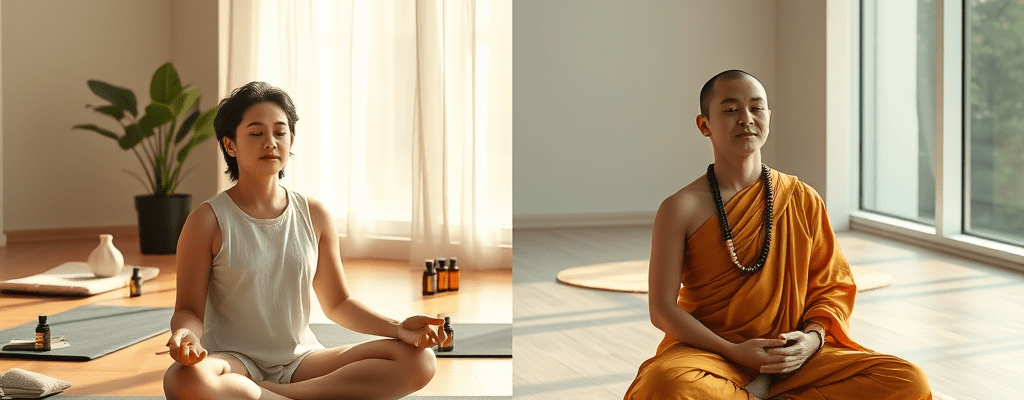
Before we proceed, let’s be clear: meditation is beneficial for the mind, just as exercise is beneficial for the body.
This series is not an argument against meditation. Rather, it serves as a set of cautions—similar to the guidance you receive at the gym: don’t lift beyond your capacity, progress gradually, watch for fatigue, and take care of your body. These warnings highlight potential risks, but they do not make exercise harmful.
In the same way, these articles explore the potential pitfalls of meditation—things to be aware of as we train and reshape the mind for greater well-being.
With that understanding, let us continue.
What is Mindfulness?
| Modern Approach | Buddhist Approach |
| focused on cultivating present-moment awareness, | intentional cultivation of bare, non-judgmental awareness of the present moment |
| non-judgmental acceptance, | Establishing Right Intent: Non-Harm, Non-greed, Non-aversion |
| curiosity toward one’s thoughts, feelings, and sensations. | to understand and realise the true nature of reality (impermanence, suffering, and no-self). |
Modern Mindfulness vs. Buddhist Mindfulness
In this post, we look at the popular form of mindfulness meditation promoted by celebrities, wellness programs, and lifestyle clubs. A natural question arises:
Is this the same as Buddhist mindfulness meditation?
If we compare the two approaches (as shown in the earlier table), we notice that the similarity is largely limited to present-moment awareness. Beyond that, the purpose, philosophical basis, and method differ significantly.
In this article, we will examine the modern approach from a Buddhist perspective. I admit that when doing so, I may appear like someone wearing a tall hat and sitting on a high horse, saying:
“You tried to copy a Buddhist technique, but removed the Buddhist wisdom behind it.”
That may sound blunt, but the difference is important.
The Objective of Modern Mindfulness
If we simplify the modern secular approach to mindfulness meditation, its underlying message often appears to be:
Learn to appreciate and love yourself.
In many wellness teachings, mindfulness is framed as a way to become comfortable with one’s inner self — accepting thoughts, emotions, and identity exactly as they are.
Some teachers go even further and suggest that the inner “I” is pure, divine, or inherently good.
This differs greatly from what the Buddha taught.
The Buddhist Perspective
In Buddhism, mindfulness is not an end in itself.
It is a tool used to condition and train the mind.
Mindfulness helps us observe our mental processes so that we can transform them in the direction of wisdom and liberation.
Rather than unconditional self-acceptance, Buddhist mindfulness operates within the framework of the Noble Eightfold Path, particularly the practice of Right Intention.
This means that when we observe our minds, we are not merely watching passively. We are also cultivating the intention to:
- reduce craving
- reduce hatred
- reduce harmful thoughts toward ourselves and others
Therefore mindfulness is not simply non-judgmental acceptance.
It is active mental training.
Accepting Imperfection — But Not Embracing It
Buddhists do acknowledge our imperfections. We recognize the greed, anger, fear, and confusion that arise in our minds.
However, the goal is not to embrace these qualities as part of our identity.
Instead, we work gradually to transform them.
Through mindful awareness and right intention, we condition the mind so that it becomes:
- less aversive
- less desirous
- less harmful
Over time this produces a balanced and peaceful state of mind.
Mindfulness, in this sense, is part of a long process of mental cultivation.
The Question of Identity
Another major difference lies in how each approach understands the nature of the mind.
Many modern mindfulness teachings assume that thoughts, emotions, and feelings are part of who we are. The practice therefore aims at understanding, accepting, and embracing one’s inner landscape.
But this assumption can create problems.
For some people, their inner world is not peaceful at all. It may be filled with anxiety, anger, painful memories, or self-destructive thoughts.
If those mental processes are believed to be the true self, then they can feel overwhelming and inescapable.
Buddhism offers a very different insight.
The Buddha taught that thoughts, emotions, and mental states are not the self. They arise due to causes and conditions and can pass away.
Because they are not us, we are not trapped by them.
We have the ability to change our relationship to them and ultimately transcend them.
Thus Buddhist mindfulness does not teach us to embrace destructive mental states. It teaches us how to see them clearly and gradually free ourselves from them.
Mindfulness as Mental Training
At its most fundamental level, Buddhist mindfulness involves two abilities:
- Recognizing physical and mental processes
- Regulating them in accordance with the Dharma
In practical terms, this means cultivating a mind that gradually moves toward:
- less greed
- less hatred
- less harm
The process is gentle and gradual.
We humbly acknowledge our shortcomings. In many traditions, practitioners recite confessional prayers, chants, or mantras to help process emotions and restore balance.
Then we return to daily life with the intention of becoming slightly better than we were yesterday.
Distraction vs. Mindfulness
Another important issue is the relationship between distraction and mindfulness.
Human beings have long used distraction as a coping mechanism.
When life becomes unpleasant, we naturally look for ways to escape:
- entertainment
- fantasies
- work
- worrying about other problems
These distractions serve as a psychological defense.
Mindfulness, however, asks us to face our inner experience directly.
Instead of escaping discomfort, we observe it.
But this can be extremely difficult.
Without proper preparation and guidance, constantly observing painful emotions or memories can overwhelm some people. For them, mindfulness may feel like staring continuously at their own suffering.
Buddhism acknowledges this reality through the teaching of Dukkha, the pervasive unsatisfactoriness of existence.
However, Buddhism also provides hope.
It teaches that suffering has a cause, and that there is a path leading to its cessation — Nirvana.
In many secular mindfulness settings, this larger framework is absent. Students may be taught to observe suffering, but not necessarily shown a path that leads beyond it.
The Need for Balance
Mindfulness does not mean dwelling endlessly on painful experiences.
When we notice our minds replaying negative memories, the goal is not simply to sit there watching them.
We must also develop the strength to let them go.
Simply saying,
“I am aware that I am reliving my painful past”
is not the end of the practice.
True mindfulness includes the ability to release the past and return to the present moment.
Living in the present means letting go of the past, not repeatedly reliving it.
Why Concentration Comes First
In Buddhist training, deeper mindfulness practice is usually supported by Samatha meditation, which develops calmness and concentration.
Why is this important?
Because concentration gives us the mental stability needed to work with difficult thoughts.
Without this stability, awareness alone can feel like being pulled into quicksand. One might notice painful thoughts arising but lack the strength to disengage from them.
Through concentration training, the mind becomes strong enough to:
- step back from harmful thought patterns
- redirect attention
- maintain emotional balance
This is why, in the Noble Eightfold Path, Right Mindfulness and Right Concentration are closely connected and support one another.
Conclusion
Mindfulness meditation is a powerful practice, but its effectiveness depends greatly on the philosophical framework in which it is taught.
In modern wellness culture, mindfulness is often presented as a tool for relaxation, self-acceptance, or personal well-being. While these benefits can certainly arise, this interpretation captures only a small part of the original Buddhist teaching.
In Buddhism, mindfulness is not merely about observing the mind. It is part of a comprehensive path of ethical discipline, mental training, and wisdom aimed at reducing suffering and ultimately attaining liberation.
Without this broader context, mindfulness can sometimes become incomplete or even risky. Observing one’s inner world without understanding the nature of suffering or without developing the mental strength to transform it may lead some practitioners into confusion or distress.
The Buddha did not teach mindfulness simply to make us more comfortable with our thoughts. He taught it so that we could see clearly, cultivate wholesome qualities, and gradually free ourselves from the forces of greed, hatred, and delusion.
When practiced within this complete framework, mindfulness is not dangerous at all. Instead, it becomes a profound path toward clarity, balance, and genuine freedom.
May all be well and happy.
To be continued
Danger of Meditation – Part 4: Why it is important to practice Jhana and the danger of Jhana from Buddhist context.
Danger of Meditation – Part 5: Why it is important to practice Vipassana and the danger from misunderstanding Non-I.
Danger of Meditation – Part 6: Third-eye meditation and your sanity. Your breath, posture, and general health. Can’t sleep after doing meditation?
(Feel free to drop a suggestion in case I missed anything, and I’ll try to talk about it if I had learnt it before)
Categories: Articles, Meditation
 I am just an ordinary guy in Singapore with a passion for Buddhism and I hope to share this passion with the community out there, across the world.


 Bodhi-Bowl