Introduction
Bodhi-Bowl returns with a powerful, introspective anthem of un-becoming: “No i.”
This track is a raw excavation of identity — moving from the suffocation of inherited labels to the liberating spaciousness of emptiness.
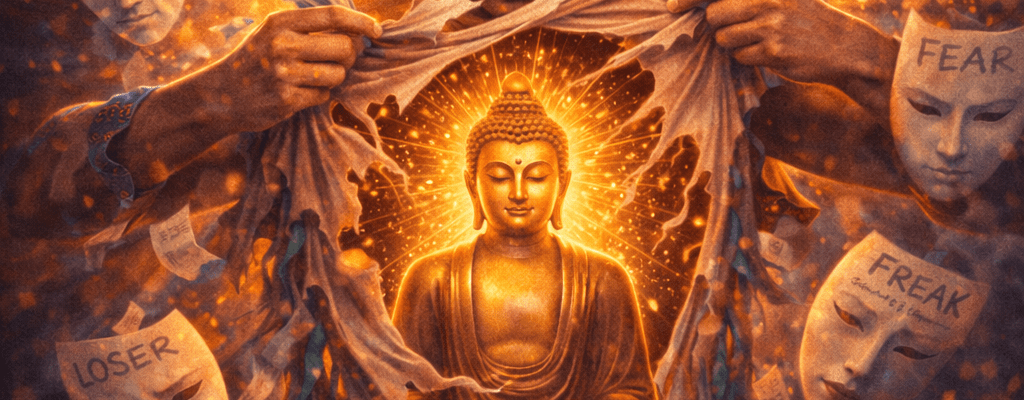
Over a brooding, wrathful, atmospheric production, the lyrics trace the painful yet necessary dismantling of “borrowed names” and “secondhand truths.” It questions the quiet assumptions we build our lives upon: the roles we were assigned, the beliefs we inherited, the masks we learned to defend.
The song does not crescendo into a new identity.
It dissolves into release.
The chorus becomes a vow — freedom from illusion, from costume, from “borrowed skin.” And that catharsis erupts into the echoing incantation of the Heart Sutra mantra in Japanese:
Gate Gate Paragate Parasamgate Bodhi Svaha
In this moment, philosophy becomes visceral.
“Form is emptiness” is no longer a concept — it becomes a battle cry.
“No i” is not about becoming someone new.
It is about the fearless freedom of standing in the open air when there is nothing left to defend.
The Story Behind the Song
“No i” is inspired by the Buddhist doctrine of Anatta (Non-Self), taught by the Buddha in the Pali Canon and central to the wisdom tradition of Buddhism.
For many people, the idea of “no soul” sounds frightening — even nihilistic.
For me, it felt like oxygen.
As a child, I was told that without faith in a particular religion, I would burn for eternity. That idea leaves a deep imprint. The fear of eternal punishment is powerful.
But if there is no fixed, permanent soul to condemn…
What exactly burns?
The teaching of Anatta does not mean we do not exist. It means what we call “self” is not a solid, eternal entity. It is a dynamic process — shaped by causes and conditions: culture, family, trauma, expectations, education, memory, fear.
When we see this clearly, identity becomes workable.
We are not trapped inside a sacred label.
We are not frozen in someone else’s definition.
We are not condemned by inherited narratives.
If the self is constructed, it can also be deconstructed.
And in that space, there is tremendous freedom.
“No i” is therefore not nihilism.
It is rebellion against psychological imprisonment.
It is permission to question what you were told you must be.
It is the courage to step outside inherited fear.
Why the Mantra?
The mantra chanted in the hook comes from the Heart Sutra, one of the most influential Mahayana Buddhist texts.
In Japanese it is chanted as:
ぎゃてい ぎゃてい はらぎゃてい
はらそうぎゃてい
ぼじそわか
This mantra points beyond conceptual thinking. It celebrates crossing over — going beyond fixed views of self and reality.
In the song, the mantra is not ornamental.
It represents the leap.
The moment when thinking collapses and something lighter remains.
Lyrics
(Verse 1)
Learning how to know myself
By stripping borrowed names
Every label on my skin
Every scripted little frame
I believed what I was handed down
Like it was written in my bones
Built a life from secondhand truths
Called it “mine,” called it “home”
(Pre-Chorus)
I was told who I would be,
before I learned how to breathe
Carved in stone, sealed tight
No room left to question me….
(Chorus)
So I’m letting go, I’m breaking through
All the masks I never choose
If I lose- what, I thought, I was
Maybe I’ll find what’s real below
I’m done defending the illusion
I’m done wearing borrowed skin
Tonight I stand in open air
And I finally let myself in
(Mantra Hook-twice) [echoes]
ぎゃてい ぎゃてい はらぎゃてい
はらそうぎゃてい
ぼじそわか
((Gya-tay, Gya-tay, Hah-rah-gya-tay, Hah-rah-soh-gya-tay Boh-jee, Soh-wah-kah)) Ha! Ha! Ha!
(Verse 2)
I was taught to harden up
Taught to hate before I heal
Taught to guard the fragile lie
That says the pain is real
I learned to fight my shadow
Learned to hide my doubt
Protected every costume
Till the fire burned me out
(Pre-Chorus 2)
I wore colors over scars
Till I couldn’t tell apart
What was armor, what was fear
What was me, what was art
(Chorus)
Now I’m letting go, I’m breaking through
All the masks I never chose
If I lose-what, I thought, I was
I’m letting go, I’m breaking through
All the masks I never chose
If I lose-what, I thought, I was
Maybe I’ll find what’s real below
I’m done defending the illusion
I’m done wearing borrowed skin
Tonight I stand in open air
And I finally let myself in
(Mantra Hook twice)
ぎゃてい ぎゃてい はらぎゃてい
はらそうぎゃてい
ぼじそわか
(Gya-tay, Gya-tay, Hah-rah-gya-tay, Hah-rah-soh-gya-tay Boh-jee, Soh-wah-kah)
(Bridge)
I was burning up inside
Trying to be someone else
Every layer peeled away
Feels like coming back to myself
No more shame, no more disguise
No more fear of what I’ll see
If there’s nothing left to prove
There’s nothing left to be
(Break / Drop)
Strip it down
Strip it bare
All that’s left is honest air
(Final Chorus)
I’m letting go, I’m breaking through
All the masks I never chose
I don’t need what shaped me then
To decide the way I grow
I’m free from every definition
Free from what you said I’d be
Standing naked in the truth
And it finally feels like me
(Outro )[Mantra Fade]
ぎゃてい ぎゃてい はらぎゃてい
はらそうぎゃてい
ぼじそわか (Gya-tay, Gya-tay, Hah-rah-gya-tay, Hah-rah-soh-gya-tay Boh-jee, Soh-wah-kah)
If This Resonates
You can find my music on Spotify and most streaming platforms under Bodhi-Bowl.
If this song speaks to something in you:
• Save it to your library
• Add it to a playlist
• Share it with someone navigating identity or spiritual doubt
These small actions tell the algorithm that Dharma-inspired music deserves to travel further.
My hope is simple:
To make Buddhist insight feel emotionally honest and relevant to the modern grind — work stress, bullying, expectation, fear, identity pressure.
If you prefer, you can also download the unmastered MP3 here on the blog.
Thank you for listening.
Thank you for questioning.
Thank you for stepping beyond.
May all be well and happy.
Categories: Articles
 I am just an ordinary guy in Singapore with a passion for Buddhism and I hope to share this passion with the community out there, across the world.


 Bodhi-Bowl