
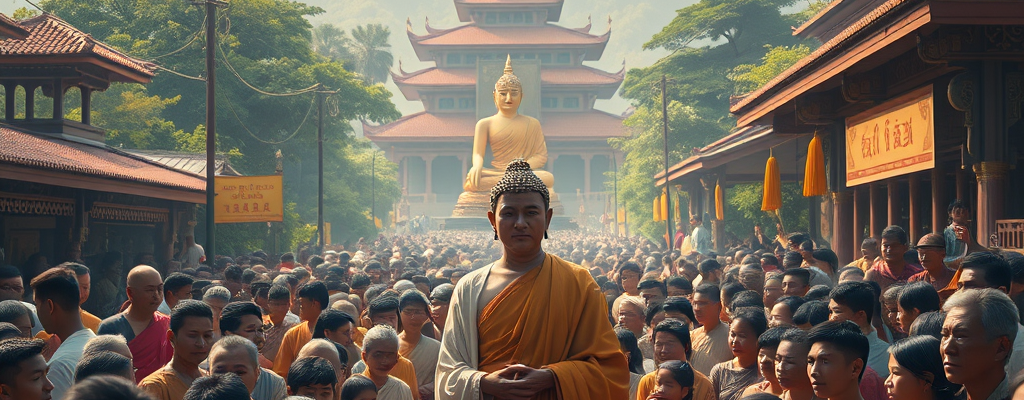
The following day, King Bimbisara invited the Buddha to the palace for a meal – an invitation the Buddha accepted. News of his arrival had already spread through Rajagriha like wildfire, fueled by the king’s personal welcome and the sensational conversion of the famous, long-haired Kassapa brothers, who now appeared with shaven heads.
As the Buddha set out for the palace, the streets swarmed with curious onlookers eager to see the former prince who had converted a thousand ascetics. With the crowd jostling and unaware of monastic etiquette, Sakka, the king of gods, disguised himself as a handsome youth to act as an usher. Walking ahead of the procession, he sang the Buddha’s praises and cleared a path for him and his thousand arhats. (This sets a precedent for Buddhist possessions; the lay people should be the ushers)
After the meal, King Bimbisara donated the Veḷuvana monastery to the Buddha and his monastic order. The Earth trembled gently to mark the significance of this first offering—a phenomenon that would not recur with any subsequent monastery gift.
The king’s motivation was practical: the Buddha and his arhats were initially residing too far from the city, and this gift provided them with a suitable and accessible dwelling.
Veluvana was chosen for its ideal balance:
- It was neither too far from the city
- nor too close to the city.
- It had good roads for travel.
- It was easily accessible to all at any time.
- Yet, it was peaceful, free from the noise and distractions of urban life.
This shows that a proper Buddhist monastery should be peaceful but not isolated—accessible to the laity yet undisturbed by their busyness.
After accepting the gift of the monastery, Buddha delivered a discourse in appreciation.
Great King, only the all-knowing Buddha could fully describe the benefits of giving someone a home. No mortal, even with ten thousand mouths, could ever explain it completely.
Great King, whoever donates a monastery gives the monastics the gifts of long life, which supports beauty, happiness, strength, and keen intelligence. [Offering of life]
Great King, by providing a monastery that offers shelter from harm, a person protects the lives of the monastics. The Buddha and all virtuous people praise such a donor for giving the gift of life. [Offeting of protection]
Great King, by providing a secure monastery, a donor gives the gifts of strength, beauty, and intelligence, which a monastic cannot sustain while exposed to harsh weather. [offering of noble qualities of life and practice]
Great King! A person, who donates a dwelling place, may be said to be a giver of happiness and well-being, because the dwelling place wards off all the suffering in the world which are caused by the hostile elements of heat, cold, reptiles, scorpions, fleas and various kinds of troubles due to wild winds and extreme intensity of heat. [offering of joy and well-being]
Great King! A person, who donates a dwelling place, wards off, through his dwelling place, the suffering caused by cold, heat, wind, sun, gnats, mosquitoes, unseasonal rain, poisonous snakes, scorpions, fleas, wild beasts, etc. Therefore, that residence supporter can, without any vestige of doubt, acquire happiness of both mind and body in his future existence.
Great King! A person, having pious devotion caused by faith and with joy in his heart, builds and gives away, in generosity, a pleasant, delightful dwelling-place, which would cause the attainment of a happy existence and prosperity, to be used as a monastery by noble monastics who are possessed of the five virtuous qualities, such as morality (sīla), and so on. All the former Buddhas had successively spoken in praise of such a supporter as one who makes a gift of these four things: strength, beauty, happiness and intelligence.
Great King! A person, having abandoned the defilements of stinginess together with greed which is craving and attachment, builds and gives away, in generosity, a monastery as a residence to noble monastics who are possessed of virtuous qualities, such as morality (sīla), etc. Just as labourers who transport and deliver goods to the desired destination, so the carrier of the volitions, convey that faithful supporter to a happy destination; consequently he is reborn in the realms of Devas where pleasant objects having five sensual pleasures abound and where no trouble arises for one’s food or shelter.
Great King! A wise man, therefore, who cares for his own interest, should have a splendid monastery built which is praiseworthy, delightful and commodious. (Note by Bodhi-bowl: Not to be mistaken as having distarcting luxuries that hamper the practice of meditaion, renunciation, and etc) He should then request monastics who possess much knowledge and experience to take up residence in his monastery. (Note by Bodhi-bowl: Experience here refers to experience of living the Sramana life, disciplined and austere. Knowledge of the dharma and its practice) He should always have devotional faith, regarding the resident monastics and deference and make joyous offerings to them of various kinds of food, drinks and robes. (Bodhi-bowl note: This refer to long-term commitment to serve and help sustain the monastics)
Great King! As a result of this donation of the monastery in pious faith, you will, therefore, repeatedly enjoy in various happy existences more and more delightful wealth. After which, you will, through realisation of the four paths and fruitions, attain the bliss and peace of Nibbāna and be entirely free of sorrow.
Having thus blessed King Bimbisāra with the discourse appreciating the dedication of the monastery, the Buddha rose from his seat and, accompanied by 1,000 monastics moved to the Veḷuvana monastery to take up residence. Following this, the Buddha permitted his monks to accept offerings of monasteries too.
It is important to observe that King Bimbisara presented a dwelling that was pre-constructed and fully suited for ascetic life, with no involvement from the Buddha or his Sangha in its planning. In short, those who wish to make such an offering should ensure the monastery is completely ready, avoiding any request for the monastics to supervise or design the construction.
In this discourse, the Buddha specified which types of monks were suitable to be gifted a monastery. While it may seem like common sense, it’s crucial to understand that monastics are those who have renounced worldly life, uphold the precepts, and are dedicated to the path toward Nirvana. They must also be well-versed in the disciplined life of a Buddhist Sramana, knowledgeable in Dharma and its practices. Not any Tom, Dick or Harry in Buddhist costumes.
This reminds me of a story about a wealthy Japanese woman who built a hermitage in her garden to support a monk. She diligently checked that he was genuinely meditating, believing her merits depended on his authentic practice. Aware of her discreet supervision, the monk applied himself diligently and ultimately achieved satori.
Last but not least, it is good to participate in donating to the construction of a Buddhist monastery, and hopefully, it will help more people gain Nirvana.
May all be well and happy.
Categories: Articles, Shakyamuni Buddha
 I am just an ordinary guy in Singapore with a passion for Buddhism and I hope to share this passion with the community out there, across the world.


 Bodhi-Bowl