While staying at the deer park, Buddha had already intended to visit Uruvela and meet the Kassapa brothers. These three brothers led a thousand fire-worshipping ascetics who believed that spiritual advancement was defined by one’s purity. The eldest Kassapa was convinced he had achieved the utmost purity and was an arhat.
First, let’s examine the story’s context.
Throughout history, people have embarked on unique spiritual quests. Many believe they possess higher knowledge, spiritual authority, or are somehow special. We see a similar trend today: people blend beliefs to find spiritual satisfaction. Some invest in their own systems, while others claim to be messiahs, priests from Atlantis, or even reborn Martians—each offering unique perspectives on the universe’s secrets and life’s purpose. In a modern example, a woman in Taiwan was recently arrested for fraud and abuse. She claims to be the reincarnation of a princess from planet Venus.
In the Buddha’s time, this phenomenon was known as the Śramaṇa movement. These were people who renounced worldly life to seek a higher purpose or spiritual breakthrough. Some became influential leaders, exerting their authority by claiming enlightened philosophical views or through mysticism.
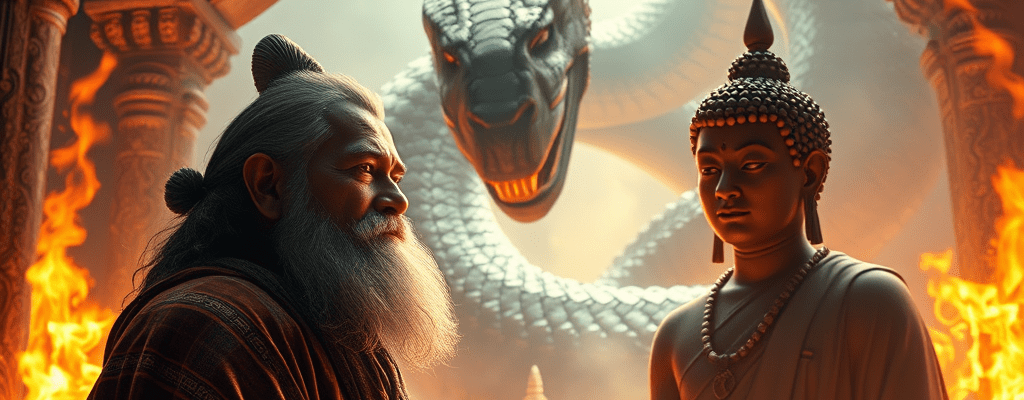
The Kassapa brothers, for instance, claimed to have attained purity of soul and were respected by a naga—a giant spiritual serpent that resided in their fire shrine. They were the only ones who could enter the shrine unharmed.
The First Miracle
According to scripture, the Buddha visited the brothers and asked to stay the night. The eldest agreed but warned that the fire shrine was restricted due to the poisonous naga.
The Buddha specifically requested to stay inside that very shrine. He asked twice, and twice Kassapa refused, citing concern for his safety. On the third request, the Buddha proclaimed the snake could not harm him. Kassapa relented, saying, “Fine! In that case, you may stay. Don’t say we never warned you.”
This must have been an awkward exchange. The Buddha’s request directly challenged the Kassapas’ spiritual authority. Were they genuinely concerned for his safety, or secretly hoping an accident would bolster their credibility? It’s important to note the Buddha had not revealed his identity yet.
That night, the naga—a giant serpent that spewed fire and poison—was subdued by the Buddha. In the morning, he walked out with the captured creature in his alms bowl. Impressed, the Kassapa brothers asked the Buddha to stay with them permanently so that they could make daily alms offerings to Buddha.
With this event at the Kassapa hermitage, the Buddha had performed his first miracle to subdue the pride of the Kassapa.
A Cascade of 16 Miracles to Challenge their misguided pride and perception
Over the following weeks and months, the Buddha engaged in a sustained demonstration of spiritual power designed to erode the brothers’ misguided beliefs.
- Celestial Homage: Over three consecutive nights, ever-more supreme celestial beings—the Four Great Kings, Sakka the King of the Devas, and finally the supreme Brahma Sahampati—appeared in radiant splendour to pay homage to the Buddha. Each time, Uruvelā Kassapa witnessed this and each time he dismissed it with the same stubborn thought: “He is mighty, but still not an Arahat like me.”
- Mastery of Space and Mind: The Buddha then demonstrated his omniscience. Reading Kassapa’s mind, he avoided a public festival to assuage the ascetic’s fear of being upstaged. Then revealed his knowledge of Kassapa’s thoughts the next day. He then performed a series of miracles that showed his mastery over space, instantly traveling to distant lands and even the Tāvatiṁsa heaven to retrieve celestial objects, always returning before Kassapa could even reach his own fire-shrine.
- Dominion over Their Elements: In a direct assault on their core practices, the Buddha asserted complete control over the element of fire. When the 500 sramanas could not split wood, light, or extinguish their sacred fires, the Buddha accomplished each task with a single thought. In an act of compassion, he even created 500 braziers to warm them after they performed a purification ritual in a freezing river.
- Mastery over Water: In a final, dramatic display, an unseasonal flood inundated the area of Buddha’s dwelling. He simply willed the waters to stay, walking on dry ground encircled by the torrents of water. When Kassapa arrived by boat, fearing he had been swept away, the Buddha levitated and landed gently beside him, proving his mastery over water and air.
Through sixteen miracles, the Buddha patiently chipped away at their pride, all while quietly accepting their alms and waiting for their understanding to mature.
The Conversion and The Fire Sermon
After nearly three months, the Buddha saw their faculties were finally ready. He directly shattered Uruvelā Kassapa’s delusion, stating: “Kassapa, you are not an Arahat. You do not even practice the path that leads to it.”
This profound truth struck Kassapa to his core. He immediately prostrated and begged for ordination. He and his 500 disciples then cast their matted locks and fire-worshipping tools into the river, symbolizing their renunciation. Seeing these signs, his two younger brothers, Nadī and Gayā Kassapa, and their 500 followers downstream also investigated and chose to follow the Buddha.
Now leading a thousand new monastics, the Buddha journeyed to Gayāsīsa. There, he delivered the perfect teaching for these former fire-worshippers: the Fire Sermon (Āditta-pariyāya Sutta). He taught that all aspects of existence are burning with the fires of passion, aversion, and delusion.
As he spoke, the minds of the thousand monastics were fully liberated. They successively attained the four paths and fruitions, becoming Arahats. The Buddha’s immense patience and skillful means had successfully guided them all from the darkness of wrong view to the complete end of suffering.
Observation & Conclusion: The Stubborn Ego, Then and Now
Reflecting on this epic saga, one can’t help but chuckle at the sheer, stubborn power of the human ego. The Kassapa brothers were the quintessential “spiritual influencers” of their day. Their brand was built on being Arahants—beings of utmost purity who had, in their own minds, transcended worldly concerns. This wasn’t just a spiritual claim; it was their business model. That identity was their ticket to veneration, a steady stream of donations, and a thousand-strong following. Letting go of it would mean admitting they were, well, just ordinary men with impressive beards and a pyromaniac streak.
One can almost imagine their internal monologue after each miracle: “Okay, so he subdued a demonic naga, commands celestial kings, reads minds, teleports across continents, and controls the weather… very impressive parlor tricks. But my inner-peace-brochure says I’m pure, so I’m just going to ignore all that evidence and stick with my story.”
The Buddha, in his infinite patience and wit, didn’t just blast them with his power. He engaged in a masterclass of subtlety, performing a veritable “Greatest Hits of Miracles” compilation just for them. It was a three-month-long campaign of gentle, cosmic hints, essentially saying, “You might want to reconsider your self-assessment.” He wasn’t just challenging their spiritual attainment; he was politely pointing out that the emperor had no clothes, and that the clothes were on fire, and that he had just extinguished them with a thought.
This story, while humorous, holds a starkly relevant mirror to our own world. The Kassapa brother archetype is alive and well. We see it in the politician who claims to be the sole savior, the guru who demands absolute devotion, or the CEO who peddles a cult of personality—all building identities on claims of unique wisdom or purity to secure their own form of “alms”: votes, power, and wealth.
The Buddha’s journey with the Kassapas is a timeless lesson. It reminds us that true wisdom isn’t about loudly claiming a title or clinging to an identity that brings us rewards. It’s about having the humility to let go of our most cherished delusions, even when they are profitable, and to finally see things—and ourselves—exactly as they are.
May all be well and happy.
Categories: Articles, Shakyamuni Buddha
 I am just an ordinary guy in Singapore with a passion for Buddhism and I hope to share this passion with the community out there, across the world.


 Bodhi-Bowl