Until now, we have learned how a Buddha appeared in this world when Śramaṇa Siddhartha Gautama attained enlightenment. We also discussed the Śramaṇa movement in ancient India, where people sought personal salvation outside of mainstream religions.
The appearance of the Buddha, the Dharma (his teachings), and enlightened disciples (the Sangha) resulted in the first community of awakened beings in this world. The enlightened beings (arhats) are very important because they validated the existence of Nirvana (ultimate happiness) and also affirmed the Buddha’s enlightenment. This is a crucial point for us to contemplate and understand deeply. If the Buddha’s enlightenment could not be validated, if Nirvana could not be experienced by people within their lifetime, then—objectively speaking—it could imply that Siddhartha’s enlightenment was just a personal hallucination.
Therefore, we must be careful when sharing Mahayana teachings and make sure not to discourage people from pursuing Nirvana in this very lifetime.
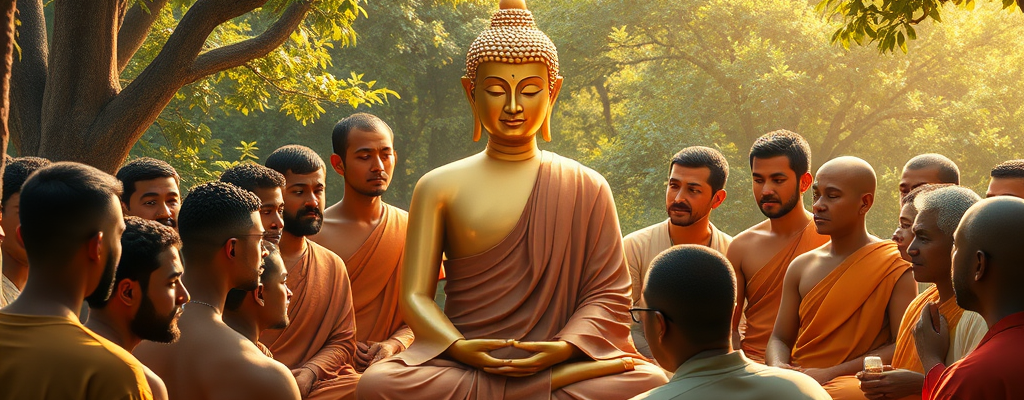
At this point in the story, the Triple Gem was firmly established: the Buddha, his teachings (the Four Noble Truths), and the 61 arhats.
These included the five companions of Ascetic Siddhartha, one visiting ascetic (the nephew of the sage who had predicted that Prince Siddhartha would become a Buddha), and 55 young men, including Yassa.
All these events took place at Isipatana (Deer Park). It was during this time that the Buddha sent out 60 missionary monks. The remaining monk chose instead to practice in deep isolation in the forest and was excluded from this assignment.
The Buddha instructed the 60 arhats to travel in different directions and share the good news of Nirvana with others. At that time, Buddhism was not ritualistic. To become a Buddhist, you simply needed to believe that Siddhartha had become remarkable—that he had fully awakened and attained supreme wisdom. You also recognized that his teachings made sense, were beneficial to society and to oneself, and that Nirvana (ultimate happiness) had been experienced by others, known as arhats. With this conviction, you expressed your own aspiration to experience ultimate happiness and committed to practicing the Buddha’s teachings.
To formalize this intention, you only needed to repeat your conviction three times. This became known as the “refuge prayers.” One would simply say: I take refuge in the Buddha. I take refuge in the Dharma. I take refuge in the Sangha—three times, after hearing the Dharma from someone who had introduced Buddhism. Can you see the dynamic “underground” movement taking shape?
Buddhism was never about praying to the Buddha for divine favors. After all, there were already many gods and deities for that role. Rather, it was about attaining ultimate happiness personally.
May all be well and happy.
Categories: Articles, Shakyamuni Buddha
 I am just an ordinary guy in Singapore with a passion for Buddhism and I hope to share this passion with the community out there, across the world.


 Bodhi-Bowl