Lady Kāḷī became A Sotāpanna
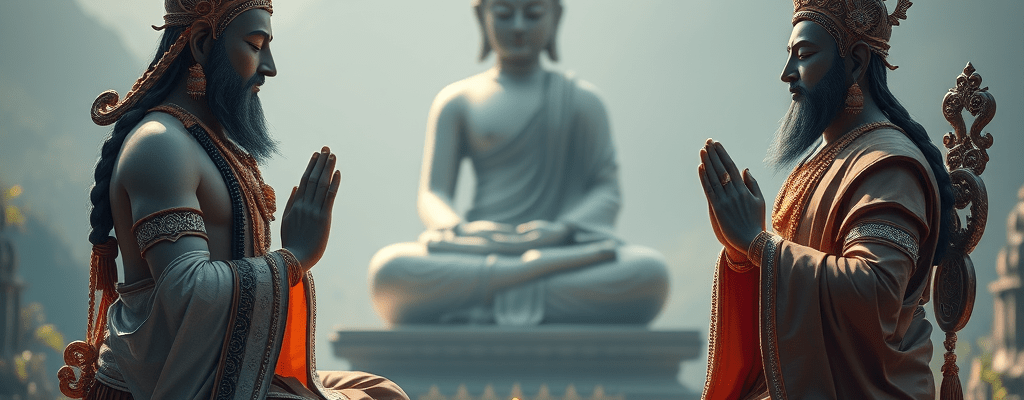
While the 2 devayakkha were conversing in the air, a pregnant noble lady below overheard everything that was being said and her name was Lady Kali.
Consequently, Lady Kāḷī was filled with joy and deep faith concerning the Buddha. Standing right there, she used that joy to clear mental hindrances and practised Vipassanā, attaining the Fruition of Sotāpatti (stream-entry). She thus became the first female noble disciple (ariyā-sāvika), regarded as the “eldest sister” of all women in the Noble Sangha. That same night, she gave birth to a son, Soṇakuṭikaṇṇa. Remarkably, she achieved enlightenment without ever seeing the Buddha, simply through faith sparked by overhearing praises of his qualities. Later, the Buddha declared her the foremost among female lay disciples who gained unshakable faith through hearing (Anussava-pasāda).
Note: This part of the story is important because it highlights that enlightenment is possible without even meeting Buddha physically. Just a strong faith and devotion with the correct frame of mind are enough to help us recognise reality. For people like us, we shouldn’t think that enlightenment is beyond our reach because Buddha had entered parinirvana. The next time we recite praises about Buddha, let’s try invoking a sense of hope, happiness and trust. Such positive energy in our mind may push us to recognise the reality of existence instead of running away from it.
The Hemavata Deva’s Question and the Buddha’s Profound Answer
At midnight, the devas Sātāgiri and Hemavata, along with a thousand devayakkhas, visited the Buddha at Isipatana. Paying respects, they sought permission to ask deep questions on the nature of existence. Hemavata inquired: What causes the world to arise, to cling, to be named, and to suffer?
The Buddha answered with a profound teaching rooted in the twelve sense bases (āyatanas): the six internal (eye, ear, nose, tongue, body, mind) and six external (form, sound, smell, taste, touch, mind-objects). These, He explained, give rise to both the world of beings (satta-loka) and the world of conditioned things (saṅkhāra-loka).
Beings cling to these bases through craving and wrong view, identifying them as ‘I’ and ‘mine’. This clinging causes the naming of self and world (outside of self), and leads to suffering. Without the arising of these twelve sense bases, there would be no perception of self, no possessions, and no suffering. Thus, the Buddha revealed the root of existence and suffering to be bound within our own perceptual framework of delusion.
Note: This part is quite mind-exploding for me. It seems to simply say that the world that we perceive as so real and material only exists because of our sensory perceptions. This reminds me of quantum mechanics, the act of observation or measurement affects the behavior of quantum systems like atoms and neutrons. This is known as the observer effect, where the system’s state is altered by the interaction with the measuring device or observer.
After hearing the Buddha’s brief answer centered on the twelve sense bases (āyatanas), Hemavata Deva, seeking deeper understanding, asked the Blessed One to explain clearly the causes of suffering (vaṭṭa) and the path to liberation (vivaṭṭa). He inquired about the root of grasping and how beings might escape suffering.
The Buddha replied that beings suffer due to attachment to the five sense pleasures—sights, sounds, smells, tastes, touches—and the mind, all rooted in the twelve sense bases. These form the ground for craving (taṇhā) and wrong view (the misconception of a self or entity = creation of a soul), leading to the cycle of suffering. Liberation comes by abandoning craving through insight, culminating in the Noble Eightfold Path.
To conclude, the Buddha affirmed: “This is the way out of the world’s suffering—truthfully taught as it is. Only this Eightfold Path brings true release from saṃsāra. There is no other way.”
In this teaching, the Buddha revealed the Four Noble Truths:
- Suffering (dukkha) arises from clinging to the sense bases.
- Its cause (samudaya) is craving.
- Cessation (nirodha) is achieved through dispassion.
- The path (magga) to that freedom is the Eightfold Path.
Thus, Hemavata Deva was shown the complete way to liberation, grounded in wisdom, insight, and practice. Upon hearing the discourse both Devas, along with their retinue of devas attained Sotapanna.
Having attained sotāpatti (stream-entry), Hemavata Deva still yearned for deeper understanding. Respectfully, he asked the Buddha to clarify the path of the trainee (sekkha) and the fully liberated (asekkha)—those who cross the turbulent ocean of saṃsāra.
He asked: Who can cross the flood of existence? Who stays afloat in the deep, boundless ocean of saṃsāra with no support above or below?
The Buddha answered in two parts:
- The Sekkha (Trainee on the Path)
One who is always pure in virtue, possesses wisdom and deep concentration, reflects inwardly with insight, and maintains unwavering mindfulness—this person, diligently training in morality (sīla), concentration (samādhi), and wisdom (paññā), can cross the dangerous flood of suffering. - The Asekkha (Liberated Arahat)
One who has fully let go of all craving for sensuality, eradicated the ten fetters through the Four Noble Paths, and destroyed delight in existence—such a being, free of all attachments and craving, no longer sinks in the ocean of saṃsāra. He has safely reached Nibbāna, unshaken and beyond rebirth.
Through this exchange, the Buddha illuminated the complete journey: from noble disciple to full liberation—crossing not only the stream, but the entire ocean of existence.
May all be well and happy.
Categories: Articles, Scriptural, Shakyamuni Buddha
 I am just an ordinary guy in Singapore with a passion for Buddhism and I hope to share this passion with the community out there, across the world.


 Bodhi-Bowl