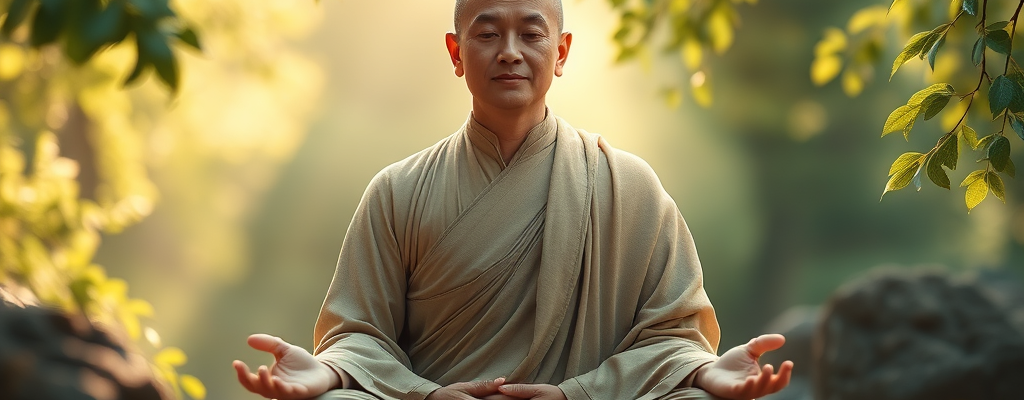
“And what, monks, is right concentration? (i) There is the case where a monk — quite withdrawn from sensuality, withdrawn from unskillful (mental) qualities — enters & remains in the first jhana: rapture & pleasure born from withdrawal, accompanied by directed thought & evaluation. (ii) With the stilling of directed thoughts & evaluations, he enters & remains in the second jhana: rapture & pleasure born of concentration, unification of awareness free from directed thought & evaluation — internal assurance. (iii) With the fading of rapture, he remains equanimous, mindful, & alert, and senses pleasure with the body. He enters & remains in the third jhana, of which the Noble Ones declare, ‘Equanimous & mindful, he has a pleasant abiding.’ (iv) With the abandoning of pleasure & pain — as with the earlier disappearance of elation & distress — he enters & remains in the fourth jhana: purity of equanimity & mindfulness, neither pleasure nor pain. This, monks, is called right concentration.”
https://www.accesstoinsight.org/tipitaka/sn/sn45/sn45.008.than.html
Right Concentration and the Path to Clarity
Right Samadhi is translated from the Pali term sammā-samādhi. Some early English Buddhist writers translated samādhi as “meditative trance.” But this can be misleading, as the word “trance” suggests a loss of control — and that is not what Right Samadhi in Buddhism is about.
In Buddhist training, Samadhi does not mean losing control or awareness. There is no danger of being “trapped” or unable to wake up from it. Instead, it is a state of deep, stable and still awareness.
In non-Buddhist traditions, Samadhi is sometimes described as merging with divine energy or presence. Buddhism does not teach that. Instead, Samadhi is a focused and still mental state — one where the mind is no longer disturbed by sensory perceptions. This stillness can feel incredibly joyful and blissful. Because of this rapture, some may wrongly assume they are experiencing Nirvana or being touched by the divine.
But in Buddhism, we clearly distinguish Samadhi from Nirvana.
How do we know its not Nirvana? Nirvana is non-reversible but Samadhi is. Once we exit Samadhi, the mind is back to craving, aversion, like, dislike; in short-Dukkha.
That said, the experience of Samadhi is considered a divine-like state. But this does not mean we are being graced by a divine being. Rather, it means our mind is temporarily as serene and blissful as the divine beings in the Brahma realms — the Brahma state.
If we cultivate and stabilize this state of mind, we may be reborn in a Brahma realm in the next life. But that is not our goal as Buddhists. Even life in the Brahma realms is impermanent and ultimately part of the unsatisfactory cycle of Samsara.
Therefore, the practice of Right Samadhi is not the final destination. It is one essential factor of the Noble Eightfold Path that helps us move towards Nirvana. Its purpose is to bring the mind to its most balanced and focused condition — so that we can observe reality clearly. And with this clarity, we can break free from the delusions of Samsara.
So, how do we practice or achieve Samadhi?
According to the suttas, the Buddha said:
“Quite withdrawn from sensuality, withdrawn from unskillful (mental) qualities…”
This means we must let go of sensual craving — stop chasing after sights, sounds, smells, tastes, tactile sensations, and even thoughts. This is the essence of renunciation. We also need to find balance in our effort — not too forceful (which leads to tension or headaches), and not too lax (which leads to sleepiness).
Put simply: follow our chosen meditation technique, and let go of everything else. Just stay with one simple task — as taught in that method.
If we keep switching techniques, we’ll likely struggle to settle. We end up jumping from one approach to another, and our mind never gets the chance to calm down.
But once the mind begins to settle, we may enter the First Jhana — the first level of Samadhi. This state is described as:
“Rapture and pleasure born from withdrawal, accompanied by directed thought and evaluation.”
We continue practicing with focus, and the mind can shift into higher Jhanas — each marked by a noticeable change. It’s like the mind is shifting gears. And we can always cross-reference with the suttas to understand and verify our experience. An important note is to abstain from imagining the supernatural. If we do that, we’ll encourage our minds to hallucinate. That is why our meditation masters always advice us to ignore what ever experiences during meditation. It could be a mysterious scent, a tactile sensation, a vision, a sound. Just remind ourselves, “Distraction” and pull our focus back to the subject of our meditation.
Conscious and Purposeful Practice
As we can see, Right Samadhi is a conscious and deliberate practice. It’s the effort to let go of sensory distractions and allow the mind to rest deeply in stillness.
Importantly, in Buddhism, we stop at the Fourth Jhana. Going beyond it into the formless states may lead to rebirth in the formless realms — which can be likened to a spiritual coma. The mind, conditioned to cling to formless Samadhi at the moment of death, ends up in a state where awakening is no longer possible. That’s not liberation.
Samadhi is Not Enlightenment
Whether we attain the First or Fourth Jhana, we must remember: Samadhi is not enlightenment. It is one factor among the eight in the Noble Eightfold Path.
But with a calm and focused mind, our mindfulness sharpens. We are no longer hijacked by emotional reactions. We gain clarity. This clarity allows us to practice the other parts of the path more effectively — Right View, Right Action, Right Speech, and so on.
Let Right Samadhi be the stable foundation — not the goal — of our path toward liberation.
May all be well and happy.
Categories: Articles, Shakyamuni Buddha
 I am just an ordinary guy in Singapore with a passion for Buddhism and I hope to share this passion with the community out there, across the world.


 Bodhi-Bowl
🙏🙏
LikeLiked by 1 person