Furthermore, bhikkhus, this is the Noble Truth of dukkha:
- Birth is dukkha,
- Old age is dukkha,
- sickness is dukkha,
- Death is dukkha,
- association with what is disliked is dukkha,
- dissociation from what is liked is dukkha,
- not to get what one wants is dukkha;
- in short, the five aggregates of attachment are dukkha.
Quote from the sutta: “In short, the five aggregates of attachment are dukkha.”
This last sentence of the verse is very important and contains the essence of emptiness, a concept that is often misunderstood in Buddhism.
It is essential to remember that Buddhists do not deny the existence of continuation after death. We simply deny the existence of a non-changing self. In this way, there is no eternal damnation in Buddhism. Each of us has the capacity to change and evolve. A being in hell can find redemption and be reborn in heaven, while an angel can fall from there.
Let’s imagine ourselves as cyborgs or robots. We understand that a robot or cyborg is merely a machine made up of mechanical parts and operated by programs. While AI may have learning capabilities, it ultimately consists of a set of codes in a computer. Wisdom means recognizing that.
Similarly, as human beings, we are composed of biological parts formed by cells and influenced by our environment. Our karma, family, society, education, religion, culture, and various other factors shape how we function. We define our way of functioning as our personality and often cling to it as our individuality. We yearn for validation from others for the myriad roles that define who we are.
At the heart of all this is an attachment to self-identification, the belief that we are unique and special. Yet, deep within ourselves, we may feel that this doesn’t quite add up. Therefore, we seek recognition, validation, and confirmation from others. We crave acknowledgment from our bosses, respect from our children, and reciprocal love from our partners, and the list goes on. Why? Because we know that we are constantly changing and evolving. Some people even experience deep anguish because of this.
Our ego and persona are fragile. From being offended by people forgetting our names to the fear of being forgotten by history. From taking offense with people who criticize our beliefs to intolerance of new cultural norms. The illusion of an ego can create much suffering and chaos.
We perceive our personality or persona to be so unique that we come to believe that there must be a unique being somewhere in our body. Attachment to that unique self generates a fear of death because we are not confident that we will continue to exist thereafter. Consequently, it is easier for us to blindly believe in an eternal “self” that lives on after death. This concept or belief is known as “Atta” in ancient India and it is commonly translated as soul.
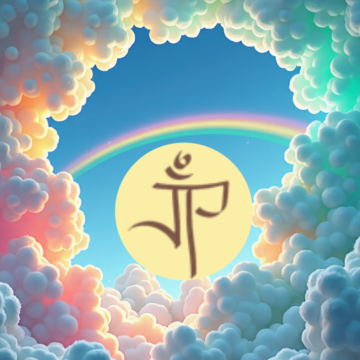
On the other hand, Buddhism teaches us to be more analytical and we champion the truth of “An-atta”. “A” serves as a negating prefix in Sanskrit and Pali. Thus, when we combine A with Atta, it becomes No-Self or No-soul. (Anatta) It is noteworthy that some Buddhists still meditate on the syllabus “A” to remind themselves of the concept of Anatta and hope to realize it one day.
The idea of non-self is not about denying existence. Buddha did not teach that we extinguish upon death. That belongs to one of the heretical teachings of an ancient Sramana movement. (It was introduced in an earlier chapter.) Neither did Buddha teach that since there is no real “I,” therefore, no one is committing karma. That also belongs to another Sramana teaching deemed heretical in Buddhism.
Anatta is more about being rational, objective, and realistic. Anatta is simply educating us to perceive ourselves as being made up of combinations of various factors, elements, and experiences. In other words, we are taught how to loosen our grip on the ego.
For example, if someone shows you the middle finger during a conversation, we feel offended. But do that to an innocent child and he will not be bothered. In ancient China, that gesture signifies a connection with the divine! Therefore, that “person” who takes offense at a middle finger gesture was simply a product of social conditioning. No one is born bothered by the middle finger. There is no inherent “I” in that.
What is the benefit of that? Well, we learn to avoid feeling insulted and losing control over something as insignificant as a middle finger gesture. If our emotions can be manipulated so easily, how powerless does that make us feel?
Understanding how we became who we are today can be incredibly liberating. For example, realizing how past traumas or ingrained biases shape our reactions allows us to work towards positive change. Anatta doesn’t deny our experiences; it empowers us to view them objectively, leading to more rational and enlightened responses.
Hopefully, this explanation helps those who fear the idea of anatta.
The last part of the first Noble Truth talks about the five aggregates. What are they?
“Aggregate” is a translation of the Pali word kandha, which could also be understood as “combination” or “grouping.” Buddha might explain it differently to a modern medical student, but for people 2600 years ago, kandha was sufficient. Even today, without deep knowledge of neuroscience, the concept remains relevant. Many have achieved enlightenment without being neurologists or psychiatrists.
These five aggregates create the illusion of a separate, unique self, leading our minds to invent the idea of a permanent soul.
- Form (rūpa): The body—solid matter, gases, temperature, fluids. We now know it’s made of cells and molecules, but the basic idea is the same: a combination of physical elements.
- Feeling (vedanā): Sensations—pleasant, unpleasant, or neutral. Feeling is a complex process, involving stimuli, receptors, and neural pathways. For example, the sensation of breathing involves air, receptors in your nose and lungs, and neural signals to your brain.
- Perception (saññā): How we perceive sensory objects. This is also a complex process involving sensory input and brain interpretation.
- Mental formations (saṅkhārā): Thoughts, intentions, volitions.
- Consciousness (viññāṇa): Awareness of the other aggregates. Through their interaction, we develop a sense of self.
These five interacting aggregates create the illusion of a self, an “I.” In reality, this “I” doesn’t exist independently. Unfortunately, most people don’t see themselves this way; they see themselves as uniquely existing individuals, creating the foundation for ego. That ego becomes a victim or an aggressor. It becomes the basis for stress, fear, sadness, etc. In short, that ego provides a basis for an “I” to experience Dukkha.
May all be well and happy
Categories: Articles, Shakyamuni Buddha
 I am just an ordinary guy in Singapore with a passion for Buddhism and I hope to share this passion with the community out there, across the world.


 Bodhi-Bowl