
Sahampati Brahma is a pivotal figure in Buddhism, revered for his fervent entreaty to Shakyamuni Buddha to share the Dharma with the world. But who is this deity, and how do Buddhists relate to him? To fully grasp this topic, we must delve into the Hindu concept of Brahma and explore his evolution over time.
In Hinduism, Brahma is revered as the “Creator” within the Trimurti. The Trimurti is a triad of Hindu deities personifying the universe’s fundamental forces: Brahma (creator), Vishnu (preserver), and Shiva (destroyer). In this aspect, Brahma is unique since there is only one Creator.
Initially, Brahma received widespread adoration and was considered the Holy Father. However, as novel theories of cosmology emerged, his spiritual significance waned, and he gradually fell out of favor. This shift reflects the dynamic nature of human understanding, where concepts of the universe and deity evolve in tandem with historical, social, and political developments.
Next, Buddhism appeared in ancient India and the enlightened Siddhartha began to teach something different altoghether.
In Buddhism, the term “Brahma” takes on a different meaning. It refers to a class of devas residing in the higher realms of existence, specifically the Form Realm (Rūpadhātu) and Formless Realm (Ārūpyadhātu). These Brahma beings are not considered creator gods, as Buddhism rejects the concept of a creator deity.
This nuance often leads to misconceptions about Sahampati Brahma. Thus, some Buddhists mistakenly believe that the Hindu creator god Brahma requested the Buddha to teach the Dharma. However, this is not supported by Buddhist scriptures.
The similarity in iconography between Sahampati Brahma and the Hindu Brahma can fuel this confusion, leading some to believe that Buddhist temples worship the Hindu creator god. Typically, Brahma is depicted with four heads, symbolizing omniscience and omnipresence. It’s essential to understand the distinct context and meaning of Brahma in Buddhism to avoid perpetuating misconceptions.
Unveiling Sahampati Brahma: A Protector and Disciple
Sahampati Brahma was a distinguished disciple of Buddha Kassapa, the predecessor of Shakyamuni Buddha. As an Anagami, he had achieved the third stage of partial enlightenment, poised to attain the final stage of Arhat. Anagamis are reborn in Pure Abode or Suddhavasa, the highest heavens in the Rupa Dhatu, where they perfect their practice and transcend Samsara.
The Realm of Suddhavasa
Suddhavasa heavens are unique, offering a refuge from the world’s destruction. Only Anagamis are reborn here, making all Brahmas residing in this realm Buddhist. These celestial beings are revered as Buddhist protectors.
The Path to Anagami
To attain Anagami, one must overcome five key obstacles:
- Belief in a permanent self (sakkāya-diṭṭhi)
- Attachment to rites and rituals (sīlabbata-parāmāsa-diṭṭhi)
- Skeptical doubt (vicikicchā)
- Sensuous craving (kāmarāga)
- Ill will or aversion (vyāpāda)
By transcending these limitations, an individual becomes an Anagami, poised for the final stage of enlightenment. Sahampati Brahma, as an Anagami, embodies this advanced stage of spiritual development, making him a revered figure in Buddhist tradition.
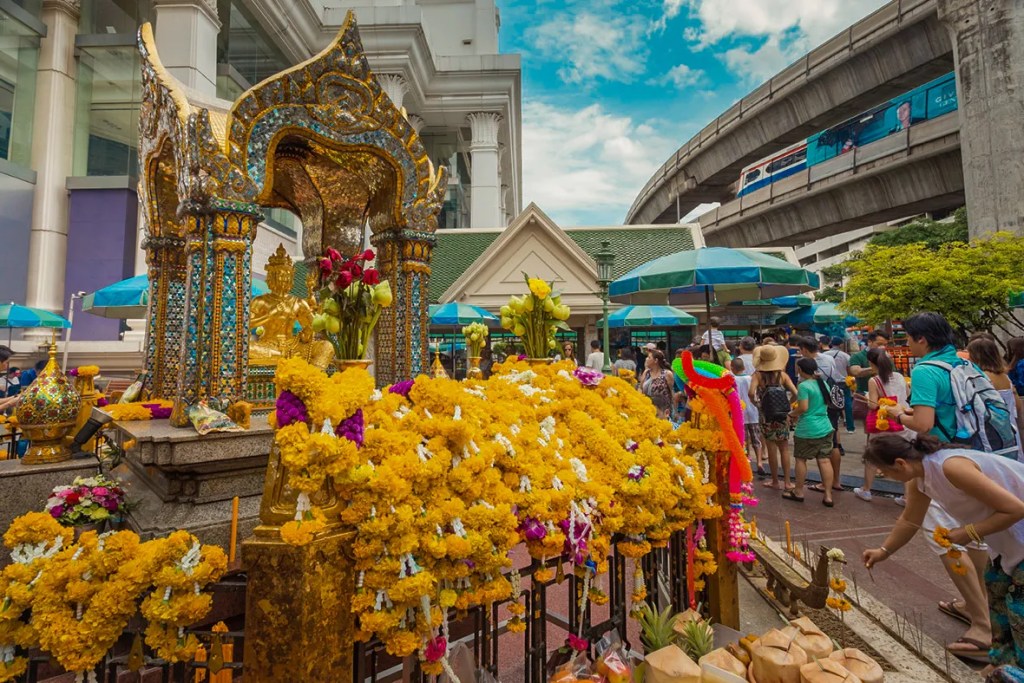
Debunking the “Four-Face Buddha” Misconception
The image of Sahampati Brahma is often installed in Thai Buddhist temples. Sometimes as a standalone shrine, like the renowned Erawan Shrine in Bangkok. However, a common misconception has arisen, labeling this image the “Four-Face Buddha.” This is incorrect, as Sahampati Brahma is not a Buddha, but rather an Anagami, a disciple of Buddha Kassapa.
The True Significance of the Four Faces
In orthodox Buddhism, the four faces of Sahampati Brahma represent the Brahmavihara practice, which cultivates four virtuous mental states:
- Loving-kindness (mettā)
- Compassion (karuṇā)
- Empathetic joy (muditā)
- Equanimity (upekkhā)
Embracing these mental states can lead to rebirth as a Brahma in the rupa heavens.
The Pop Buddhism Misconception
In contrast, pop Buddhism has distorted the meaning of Sahampati Brahma’s image, associating each face with mundane aspirations: Moving clockwise,
- Front Face: Fame, studies, career, future
- Second Face: Relationships, attraction, nobility
- Third Face: Fortune, work
- Fourth Face: Health, sickness, diseases, safety, family’s health
This misconception undermines the original significance of Sahampati Brahma’s image, which represents a profound spiritual practice, not a means to fulfill worldly desires.
The Subjective Nature of Sacred Icons
Indeed, a statue can hold diverse meanings for different individuals, reflecting their unique beliefs, values, and experiences. The image of Sahampati Brahma serves as a poignant example:
- For Buddhists, it represents the third stage of enlightenment, the Suddhavasa heavens, and the Brahmavihara meditation practices.
- For some, it’s a deity granting wishes and fulfilling desires.
- For Hindus, it symbolizes the creator god Brahma, embodying benevolence and love.
The Power of Perception
This highlights the significance of our minds in shaping our understanding of the divine. Our thoughts, experiences, and beliefs lend personality to the gods we worship, making them a reflection of our inner selves.
For example, there was an urban legend about one Asian celebrity praying to a statue of Sahampati Brahma for some worldly desires. The story goes that the celebrity’s wish was granted, but the deity then appeared in her dream with a disturbing request: to perform a naked dance routine in front of the statue in public!
An Orthodox Buddhist Perspective
From an orthodox Buddhist standpoint, this request is absurd and likely the work of a fallen Gandharbha (a malevolent being). This highlights the importance of proper understanding and discernment in spiritual practices. Because our minds shape our gods.
May all be well and happy.
Categories: Articles
 I am just an ordinary guy in Singapore with a passion for Buddhism and I hope to share this passion with the community out there, across the world.


 Bodhi-Bowl