
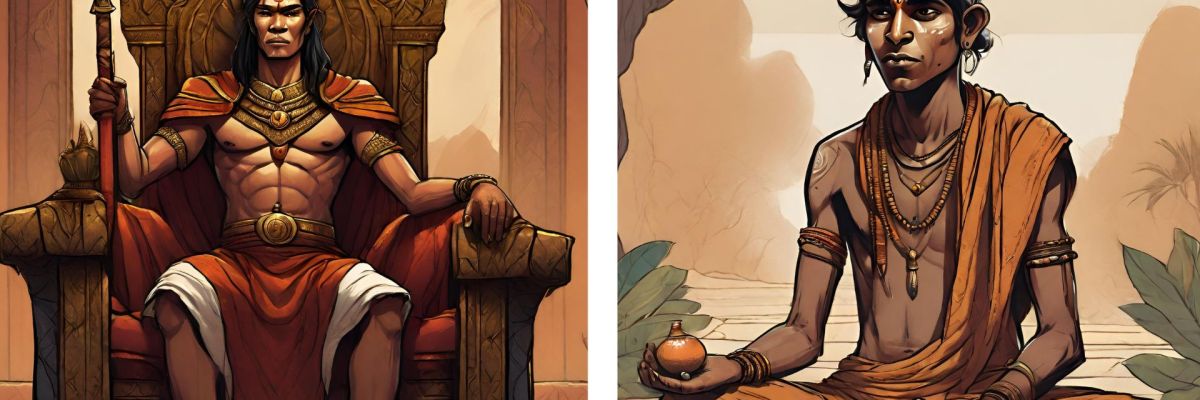
Asita’s Revelation:
King Suddhodana had a spiritual mentor by the name of Asita. Prior to his retirement, Asita served as a royal seer but later withdrew to the Himalayas. As a hermit, Asita dedicated much of his time in profound meditation that enabled his consciousness to transcend into the celestial realm. Therefore, he became aware of the imminent birth of a bodhisattva from the celestial beings. Filled with eager anticipation, he promptly made his way to the royal court to meet the infant bodhisattva.
A Blessing Beyond Words:
Upon Asita’s arrival in Kapilavastu, Queen Maya had already returned with her newborn, and the young prince had become the center of attention. King Suddhodana was pleasantly surprised by Asita’s unexpected visit and greeted him with profound respect. Upon learning the purpose of Asita’s visit, King Suddhodana eagerly presented his infant son with a great sense of pride.
Intrigued by the presence of the baby, Asita leaned in to closely examine the child’s features as he lay in the crib. According to ancient beliefs, physical characteristics of the entire body can reveal one’s character, fortune, and even life’s destiny, much like the practices of palm reading and physiognomy.
However, just as Asita was drawing near to get a better look, the baby extended his tiny leg, and with a gentle touch, graced the sage’s head with his tiny foot. In that profound moment, Asita experienced a revelation – this child would illuminate the world with the brilliance of wisdom. Filled with uncontainable joy, Asita laughed with jubilation and paid his utmost respects to the infant prince. King Suddhodana, who stood beside Asita, bore witness to his guru’s profound act of veneration.
Discussion
- Do you believe in fate and destiny?
- Do Buddhist believe in fortune telling and destiny?
- How will such beliefs contradict the doctrine of Karma?
An Unprecedented Gesture:
King Suddhodana had previously participated in numerous religious ceremonies alongside Asita during Asita’s tenure as a royal seer. It was customary for Suddhodana to emulate Asita’s actions during these rituals. On this particular occasion, when King Suddhodana observed his Guru bowing in reverence to the infant Siddhartha, he instinctively followed suit habitually.
This impromptu gesture of paying homage to his son became a controversy within the court because the act of a father showing obeisance to his own son was unprecedented in Asian culture.
This incident marked the very first instance of King Suddhodana displaying respect and reverence towards his son.
A Puzzling Turn of Events:
However, just as swiftly as the atmosphere was filled with joy, Asita’s demeanor changed dramatically. The room fell into a hush as the sage began to weep uncontrollably. His sudden sorrow perplexed everyone present and the Shakyan anxiously inquired the source of his distress.
Asita explained that his sorrow was not for a calamity befalling the prince, but rather for his own mortality. Asita lamented that he would not live long enough to receive teachings from the young prince, indicating the profound wisdom Siddhartha was destined to possess and impart.
A Father’s Dilemma:
While everyone found solace in Asita’s lack of foreboding for the baby prince, King Suddhodana couldn’t help but be troubled by the implications of Asita’s words. He held aspirations of his son ascending to the throne, rather than embarking on a spiritual journey to become a teacher! Although King Suddhodana held his spiritual mentor in high esteem, he unwittingly found himself rejecting the wisdom of his guru this time.
Discussion
- Parents know the best. Do you agree with this statement?
- Many parents desire the best for their children and inevitably, that leads to making plans about their children’s education, hobbies and interests, social circles, and even marriage, etc. Do you agree that guiding or shaping the future of our children is part of our parenting responsibility?
- If so, how much planning or interference is considered healthy?
The Quest for Clarity:
Perhaps it was to gain further insights into Siddhartha’s future or perhaps it was simply to seek alternative opinions.
In an effort to gain fresh insights into Prince Siddhartha’s fate, King Suddhodana arranged a naming ceremony and extended invitations to 108 revered spiritual leaders. From this esteemed group of religious men, eight of the best were invited to re-tell the fortune and destiny of Prince Siddhartha.
The newborn prince was formally named Siddhartha in this naming ceremony and Siddhartha means “all wishes fulfilled, will be fulfilled.”
The Seers’ Prophecies:
Among the distinguished group of eight holy men, seven foretold that Siddhartha’s future held the potential to either become a great king or a great seer. However, it was the youngest among them, Sudatta of the Brahmin Clan of Kondanna, who delivered a distinctive and audacious prophecy – he proclaimed that Siddhartha would unquestionably emerge as the preeminent seer, the epitome of wisdom, the Buddha!
Confronted with these divergent possibilities, the King felt compelled to exert every effort within his means to mold Prince Siddhartha’s destiny into that of a great king.
May all be well and happy.
Categories: Articles, Shakyamuni Buddha
 I am just an ordinary guy in Singapore with a passion for Buddhism and I hope to share this passion with the community out there, across the world.


 Bodhi-Bowl