Only a remarkable story or is there more to it?
Introduction:
In the previous chapter, Queen Maya had expressed her desire to visit the land of her birth, the Koliya country. In response to her wish, King Suddhodana organized elaborate preparations for her journey from Kapilavastu, the capital of the Shakya country, to Devadaha, the capital of Koliya.
As the grand procession made its way towards Devadaha, it passed by a picturesque garden that held significance for both the Shakyan and Koliyan people. This garden, known as Lumbini Park, was located in present day Nepal.
Lumbini Park was a breathtaking sight at that time, adorned with flourishing sala trees and fragrant blossoms. The air was filled with the melodies of singing birds and the gentle buzz of bees. The serene and enchanting scenery captivated Queen Maya’s heart, prompting her to instruct the bearers to pause for a while. This account provides insight into Queen Maya’s well-being during her journey, as she did not experience any discomfort and remained in good health. As per widely accepted accounts, Queen Maya was leisurely walking through the park, relishing her surroundings, when she sensed the impending onset of childbirth.
1. The gathering of Deva
In Buddhist stories, celestial beings from various heavens gathered to witness the birth of a potential Buddha. It’s worth noting that before this birth, the bodhisattva was also a celestial being in Tushita Heaven. From this perspective, it seems that the Buddha’s birth united all beings in the celestial realm.
Although Buddhism is commonly considered atheistic, it acknowledges the existence of higher celestial beings. It teaches that the celestial dimension is also part of Samsara or the cycle of unenlightened existence. These celestial beings are distinct individuals, but the Buddha taught that they are reborn as celestial beings due to their good karma, symbolizing common goodness.
In this story, we observe the embodiment of goodness coming together to celebrate the birth of wisdom in the human world. There is no competition for space or power, no hierarchy of rulers and subjects, and no claims of superiority among these divine beings. It’s like one harmonious family. Common Goodness.
Perhaps the underlying theme in this narrative is the joy felt by these divine beings that someone of immense wisdom has finally been born among ignorant humans. Maybe this signifies the end of religious wars and conflicts. While this might be wishful thinking, considering the disagreements among followers of different deities, it’s comforting to believe that the underlying message is one of inclusivity and harmony.
Discussion Points:
- Explore the significance of celestial beings in Buddhist cosmology.
- Investigate how celestial beings relate to the concept of karma in Buddhism.
- Examine the concept of atheism in Buddhism and how it differs from other religious beliefs.
- Analyze how Buddhism’s atheistic nature coexists with the acknowledgment of celestial beings.
2. The Miraculous Birth:
The day of the Buddha’s birth fell on a Friday, a highly auspicious full moon day when the moon was aligned with the Visakha constellation. This day continues to be observed as Vesak Day, a sacred occasion in Buddhism.
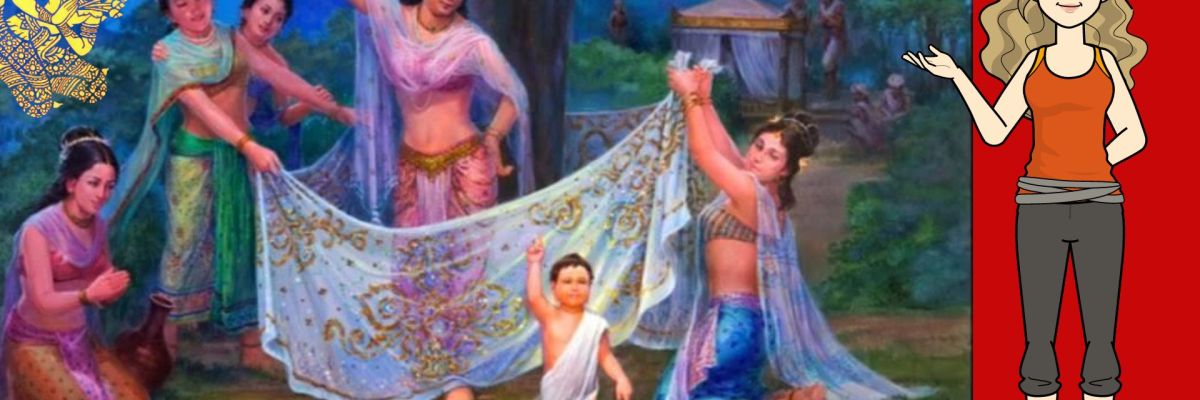
Beyond ordinary human perception, the divine baby was received by celestial beings from the Brahma realm and other heavenly realms before being placed in human hands. To the amazement of all present, the infant Buddha independently rose to his feet and took seven steps in the northern direction, with a lotus flower appearing on the ground at each step. Upon the seventh step, he paused and spoke with a dignified voice:
“I am the leader of the world, The eldest among all in the world, The foremost figure in the world. This marks my final birth. There will be no more rebirth for me.”
Interpretation
Buddhism is rich in captivating narratives that are interwoven into its sacred texts. These stories serve as a source of inspiration for devout followers, encouraging them to courageously practice the teachings of the Buddha. Take, for instance, the principle of non-violence in the face of adversity is a concept that demands unwavering commitment from ordinary individuals.
Simultaneously, these remarkable stories are not only memorable but also serve as aids for understanding and memorising intricate or profound concepts. The crucial question that arises is whether these stories harbor hidden meanings. To unravel these deeper teachings, one requires an inquisitive audience and the guidance of a knowledgeable teacher.
Now, let’s delve into the significance of the miraculous birth of the Buddha:
Despite the physical vulnerability inherent in a human being, the Buddha-nature or wisdom remains eternally potent. Consequently, the narrative portrays an infant Buddha displaying abilities that are beyond the reach of an ordinary baby.
In this light, the birth of wisdom is effortless and spontaneous, cherished and revered by the divine.
Let us now explore the deeper meaning of this miraculous birth according to traditional scriptural commentaries:
The seven steps taken by the baby Buddha symbolize complete mastery of the seven factors that lead to enlightenment: [1] Mindfulness, [2] Investigation of the true nature of reality, [3] Determination, [4] Joy or Bliss resulting from attainments, [5] Tranquility, [6] Concentration or Jhana, and [7] Equanimity.
The northward direction signifies supremacy over unenlightened beings. Being unenlightened means being ensnared in the cycle of Samsara, while enlightenment or Nirvana represents liberation. Therefore, enlightenment is superior.
Moreover, the concept of north holds significance in navigation, paralleling the Buddhist goal of attaining enlightenment. Thus, it underscores the importance of maintaining mindfulness towards enlightenment as a spiritual objective.
The lotus flowers appearing beneath the baby Buddha’s feet symbolize purity amidst defilements, representing the ascent beyond the muddied waters of Samsara to blossom untarnished, much like a lotus flower.
How do we interpret the baby Buddha’s proclamation?
“I am the leader of the world, The eldest among all in the world, The foremost figure in the world. This marks my final birth. There will be no more rebirth for me.”
Leader of the world refers to Buddha’s role as an educator who led sentient beings out of suffering.
He is the eldest in the world because he remembers all his previous existences upon enlightenment. Or, Buddha-nature being ageless.
He is foremost because he rediscovered enlightenment and taught the Dharma after it had been forgotten. Or Buddha-nature is the ultimate inherent potential of all sentient beings, thus it is foremost.
This marks my final birth. There will be no more rebirth for me. This refers to his enlightenment and absolute freedom from Samsara.
Conclusion:
In conclusion, the miraculous birth story of the Buddha continues to inspire and resonate with its followers. Underlying this remarkable tale are profound messages. It tells us that despite the physical vulnerability inherent in human birth, the wisdom of our Buddha-nature remains ever potent. Wisdom transcends physical limitations, it manifests and proclaims itself; And the birth of wisdom arises effortlessly and spontaneously, an event that is cherished and revered by the divine. Resulting in unity instead of division.
Discussion points
- Discuss the significance of “hidden” concepts or teachings in Buddhist stories.
- Are they apparent from the stories?
- Is it important to know them?
Again, I hope this study guide will come in handy for anyone who wishes to hold a Dharma Discussion Group. Feel free to make use of this but please refrain from making any monetary gains from it.
May all be well and happy.
Categories: Articles, Shakyamuni Buddha
 I am just an ordinary guy in Singapore with a passion for Buddhism and I hope to share this passion with the community out there, across the world.


 Bodhi-Bowl