For the past six years on bodhi-bowl.com, I’ve written about Buddhist wisdom in essays, reflections, and commentary.
But lately, I’ve been releasing something different.
Songs.
Some people may wonder why.
Why package Dharma in pop music?
Why wrap ancient teachings in atmospheric beats, hooks, and explosive mantra drops?
Here’s why.
1. The Buddha’s Message Is Universal
I believe the Buddha’s teachings on wisdom, clarity, compassion, and inner freedom are not limited to people who identify as Buddhist.
Stress is universal.
Anxiety is universal.
Grief, comparison, pressure, burnout — universal.
The insight into impermanence, non-self, and compassion can benefit anyone navigating modern life — regardless of religious label.
Dharma does not require conversion.
It requires reflection.
If wisdom can help reduce suffering, it deserves wider pathways.
2. Many People Never Consciously Access the Dharma
Most people do not attend Dharma talks.
They do not read Buddhist texts.
They may never walk into a temple.
Some assume Buddhism is ritualistic.
Some think it is only about monks.
Some simply have no exposure at all.
In today’s world, attention is fragmented. Long-form religious study is rare.
But music?
Music enters spaces where sermons do not.
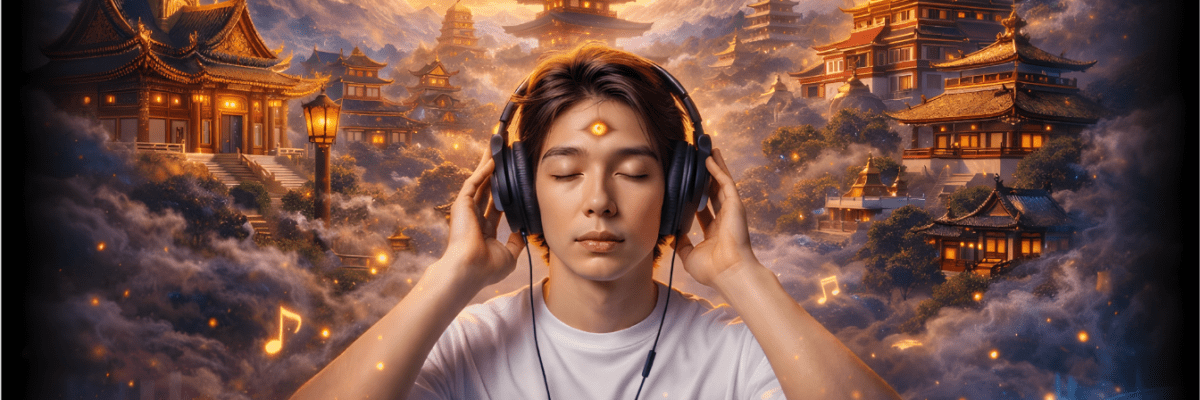
It slips into headphones on the train.
It plays in gyms.
It hums quietly after a stressful workday.
If Dharma only lives in books and formal talks, it misses entire audiences.
3. Pop Music Is a Cultural Language
Pop music is one of the most accessible languages on earth.
Hooks repeat.
Melodies linger.
Lyrics stay in memory long after the song ends.
A single line in a chorus can do what a ten-page essay cannot —
it can echo inside someone during a difficult moment.
When I embed Dharma themes inside emotionally resonant pop structures, I am not diluting the teachings.
I am translating them.
4. Not Everyone Is Receptive to Traditional Formats
Traditional Dharma talks are powerful — but they require a certain posture: quiet attention, intentional learning, sometimes prior belief.
Music requires none of that.
You don’t have to agree with a philosophy to feel a song.
You don’t have to “believe” to resonate emotionally.
Some people will never pick up a Buddhist book.
But they might press play.
And that is enough.
5. Entertainment Is Already Part of Daily Life
Whether we admit it or not, entertainment shapes us.
We consume music while:
- Working out
- Driving
- Studying
- Recovering from heartbreak
- Escaping workplace stress
Music regulates emotion.
It amplifies courage.
It helps us process pain.
If music is already influencing our emotional landscape, why not let it carry something nourishing?
Listening to Dharma encouragement through worldly music brings wisdom down to ground level — into the exact spaces where people struggle.
6. Dharma Is Not Only About Calm
There is a stereotype that Buddhist music must be soft, slow, and meditative.
But life is not always serene.
Sometimes we feel anger.
Sometimes we feel defiant.
Sometimes we need courage, not calm.
My music is not limited to peaceful tracks designed for quiet escape.
For example, “No i” is not a lullaby.
It is an eruption.
It channels the teaching of non-self (Anatta) into a fierce anthem about breaking inherited identities and stepping beyond fear.
Dharma can whisper.
But sometimes it needs to roar.
7. Emotional Entry Points Matter
Many people do not begin their spiritual journey through philosophy.
They begin through pain.
Through burnout.
Through rejection.
Through existential doubt.
Pop music speaks directly to those emotional entry points.
If a listener first connects to the feeling —
and only later becomes curious about the teaching behind it —
then the bridge has already been built.
8. This Is Not Replacement — It’s Expansion
I am not replacing traditional Dharma.
Temples, monks, scholars, and teachers remain essential.
This is simply another doorway.
A supplementary channel.
A way to plant seeds in places where formal teachings rarely travel.
If even one listener becomes curious enough to explore deeper Buddhist teachings because of a song, the experiment is worthwhile.
9. Dharma Belongs in the Modern World
We live in the age of streaming platforms, algorithms, and short attention spans.
If Buddhist wisdom remains confined to ancient formats alone, it risks becoming culturally invisible.
But if it enters playlists, headphones, and daily routines —
it lives.
Not as nostalgia.
But as living practice.
10. My Intention
My goal is simple:
To make Buddhist insight feel emotionally honest and relevant to the modern grind —
work stress, bullying, identity pressure, social expectation, burnout.
I release Dharma as pop music because:
Wisdom should travel.
Compassion should circulate.
Freedom should be heard.
If a melody can carry even a fragment of clarity into someone’s day, that is enough.
Be Part of the Experiment
This is, in many ways, an experiment.
Can Dharma travel through pop hooks and streaming algorithms?
Can wisdom ride alongside gym playlists and late-night commutes?
Can a mantra echo inside someone who has never stepped into a temple?
I don’t know how far it will go.
But I do know this: experiments require participation.
If you believe that the Buddha’s teachings on wisdom and compassion deserve wider pathways, you can be part of that effort.
By following Bodhi-Bowl on Spotify,
by saving a song,
by adding it to your playlist,
by sharing it with someone navigating stress, identity pressure, or doubt —
you are not just supporting a musician.
You are helping Dharma circulate in modern spaces.
On streaming platforms, small actions matter. A follow tells the algorithm this voice should travel. A save tells it the message resonates. A share opens a new doorway.
If this project succeeds, it will not be because of marketing alone.
It will be because a small community chose to participate in the experiment.
In Buddhism, we speak of merit — the quiet accumulation of wholesome conditions that support well-being and wisdom.
If this music plants seeds of reflection, courage, or compassion in someone’s life, then anyone who helped it travel shares in that merit.
So if this vision resonates with you:
Follow.
Save.
Share.
And let’s see how far Dharma can travel in the language of pop.
May all be well and happy.
Categories: Articles
 I am just an ordinary guy in Singapore with a passion for Buddhism and I hope to share this passion with the community out there, across the world.


 Bodhi-Bowl