
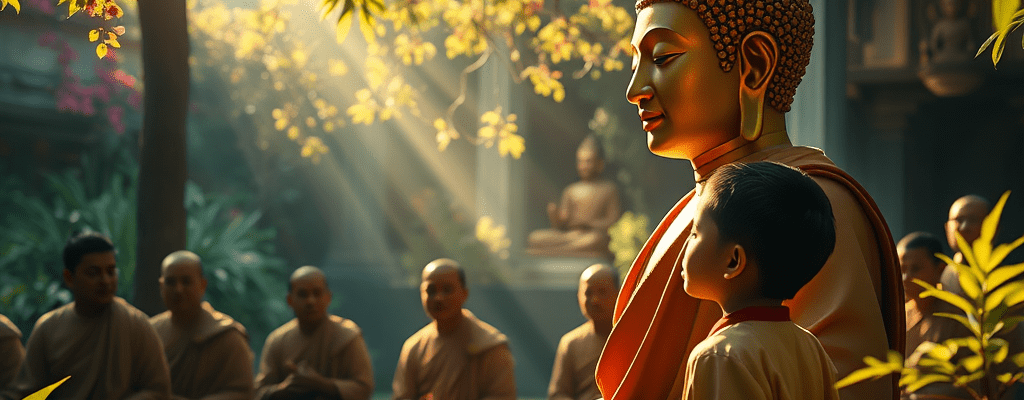
Seven days after Prince Nanda entered the monastic order, the Buddha returned to the palace of his father, King Suddhodana, accompanied by 20,000 Arahats.
Princess Yasodharā dressed her seven-year-old son Rāhula beautifully and pointed toward the Buddha seated among the monks:
“My son, that noble monastic with the golden complexion and Brahma-like grace is your father. Before he renounced the palace, four magical golden pots — Saṅkha, Ela, Uppala, and Puṇḍarīka — appeared at his birth and vanished at his renunciation. They are your inheritance. Go and ask him for them.”
These four vessels were said to be inexhaustible treasure pots, constantly replenishing gold and precious valuables. Yasodharā, like any mother, was thinking of her son’s future — stability, kingship, legacy.
At this moment, we see something very human: a mother seeking worldly security for her child.
A Child’s Request
When young Rāhula approached the Buddha, he felt not royalty, but warmth — the quiet protection of a father. After the meal, as the Buddha departed for the Nigrodha Monastery, the little boy followed behind him repeating:
“Father, give me my inheritance.”
The Buddha did not tell him to return. No one stopped him. A son was following his father.
By the time they reached the monastery, the Buddha reflected:
“Worldly wealth leads only to further becoming and suffering. Instead, I shall give my son the inheritance of the Noble Ones.”
And what is that inheritance?
The seven noble treasures:
- Faith (saddhā)
- Morality (sīla)
- Conscience (hirī)
- Moral caution (ottappa)
- Learning (suta)
- Generosity (cāga)
- Wisdom (paññā)
He instructed Venerable Sāriputta to ordain Rāhula as a novice. Thus, while the child asked for gold, he received the Dhamma.
He became the youngest member of the Saṅgha.
A King’s Sorrow
When King Suddhodana heard the news, he was deeply shaken.
First his son renounced the throne.
Then Prince Nanda.
Now his only grandson.
The royal succession was dissolving before his eyes.
The texts describe the king as a once-returner — spiritually advanced, yet not entirely free from mental pain. His grief was not ignorance; it was parental love mixed with responsibility.
He approached the Buddha respectfully:
“My son, I ask a favour.”
The Buddha replied:
“Fully Awakened Ones are beyond granting favours.”
This is important. The Buddha does not operate in the economy of worldly favours. Enlightenment is not a bargaining position.
The king clarified that his request would be proper and blameless. Only then did the Buddha invite him to speak.
The king said:
“When you renounced, I suffered. When Nanda ordained, I suffered again. Now Rāhula has gone forth, and my sorrow is immeasurable. The love of parents penetrates to the very marrow.”
This was not anger. It was vulnerability.
And the Buddha listened.
A Rule Is Established
In response, the Buddha laid down a training rule:
A minor may not be ordained without the consent of both parents.
Here we see something profound. The Buddha did not dismiss the king’s concern as merely “worldly attachment.” He adjusted the monastic discipline to acknowledge familial responsibility.
Compassion operates in context.
The Silent Sorrows
The texts are quiet about Yasodharā’s inner world. We can only imagine.
Did she secretly hope Rāhula’s request might draw the Buddha back to palace life?
Was she anxious about her son’s security?
Did she feel abandoned — first by husband, then by child?
After Rāhula’s ordination, she was alone in the palace.
King Suddhodana, too, faced the dismantling of every dream he once held for his lineage. From a worldly perspective, the Buddha’s return ended the dynasty he had built his life around.
Yet neither king nor princess reacted with vengeance or force.
No expulsion.
No coercion.
No abuse of power.
Instead — dialogue. Adjustment. Coexistence.
When Values Collide
This story is not merely about renunciation. It is about differing values.
- Yasodharā valued worldly security.
- Rāhula wanted closeness to his father.
- The king valued continuity and responsibility.
- The Buddha valued liberation beyond all of that.
Even among noble beings, misalignment creates temporary pain.
And this is where the story becomes uncomfortably relevant.
In our own lives, much suffering arises not from enemies, but from mismatched expectations:
- Different priorities
- Different visions of success
- Different beliefs
- Different fears
We call it injustice. We call it betrayal. We call it unfairness.
But often, it is simply differing values colliding.
Compromise Without Compromise
What is remarkable is how each party responded.
The Buddha did not retract Rāhula’s ordination — he did not compromise the Dhamma.
Yet he amended the rules to honour parental consent.
The king did not demand his grandson’s return — he sought accommodation, not domination.
Yasodharā, though silent in the texts, ultimately adapted to a new reality.
They did not insist on winning.
They chose adjustment over aggression.
This is a rare quality in our world today.
From neighbours arguing over culture, to leaders clashing over ideology, we see power asserted without restraint. Everyone demands alignment.
Yet this ancient episode offers a quieter strength:
Firm in principles, flexible in conduct.
What Is Our Inheritance?
Rāhula asked for gold and received the path to awakening.
Perhaps the deeper question is this:
What are we asking for in life?
And what are we actually being given?
Sometimes we ask for treasure pots.
Life hands us training instead.
If we look carefully, the real inheritance may not be what we first imagined — but it may be infinitely more valuable.
And perhaps, when our expectations do not match the world, instead of reacting with hostility, we can pause and learn from this royal family:
Meet halfway.
Adjust where possible.
Hold principles gently.
And remember that even love can hurt when values differ.
That understanding itself may be part of the noble inheritance.
Reflection Points for a Buddhist Study Group
1. What Are We Really Asking For?
- When Rāhula asked for his “inheritance,” what was he truly seeking — wealth, status, or connection with his father?
- In our own lives, when we ask for success, money, recognition — what are we actually longing for underneath?
- Have you ever asked for something worldly and later realised you received something spiritually more valuable in life?
2. Silent Suffering
The texts are largely silent about Yasodharā’s inner world.
- Why do you think the scriptures sometimes leave emotional spaces unspoken?
- How do we practise empathy toward the “silent characters” in our own lives?
- Are there people around us quietly adapting while we pursue our goals?
May all be well and happy.
Categories: Articles, Shakyamuni Buddha
 I am just an ordinary guy in Singapore with a passion for Buddhism and I hope to share this passion with the community out there, across the world.


 Bodhi-Bowl