King Suddhodana and the Shock of No-Self
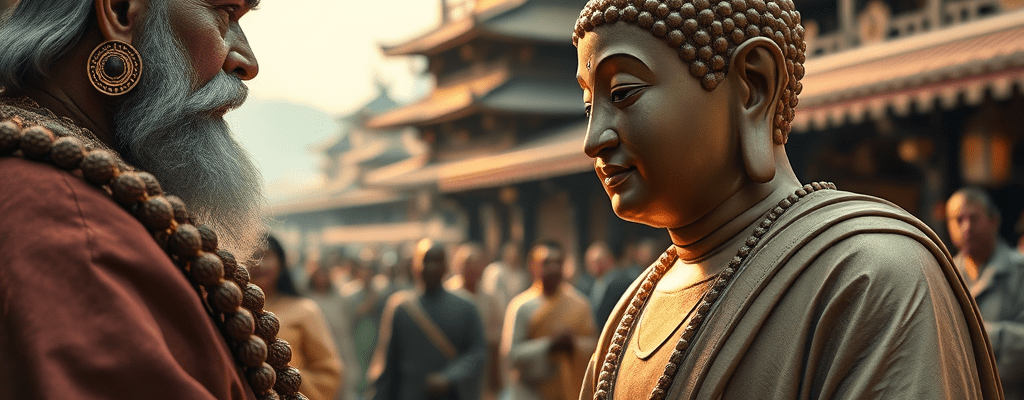
When King Suddhodana heard that his son was walking through the city begging for alms from door to door, he was deeply shocked and disturbed. Without waiting for his royal escort, he rushed out of the palace, confronted the Buddha, and spoke with agitation:
“Most Fortunate One (Bhagavān), why do you bring shame upon us—the royal family—by going on alms round? Do you think your royal father cannot provide enough food for you and the twenty thousand arahats who accompany you?”
The Buddha replied calmly:
“Royal father, this practice of receiving alms from door to door (sapadāna-cārika) is the unbroken tradition of all Buddhas.”
King Suddhodana objected strongly:
“My son, are we not descendants of a noble khattiya lineage—great elected rulers in an unbroken succession since the beginning of this aeon? Among all our ancestors, there has never been one who went begging for alms.”
The Buddha then made his decisive reply:
“Royal father, the lineage of noble rulers is indeed your lineage. But my lineage is the lineage of the Buddhas. From Dīpaṅkara, Koṇḍañña, Maṅgala, and down to Kassapa, twenty-four Buddhas before me—and countless others, as numerous as the sands of the Ganges—have all lived by going from house to house to receive alms. This practice has always been our means of livelihood.”
A Shift in Identity
Up to this point, we see that a monastic may still maintain contact with family. But something fundamental has changed: a monastic no longer identifies themselves as belonging to that family. Instead, they identify with a spiritual lineage.
For this reason, many Buddhist traditions poetically refer to monks and nuns as sons and daughters of the Buddha.
Stopping briefly on the road, the Buddha then uttered the following verse (Dhammapada 168):
“One should rise up and not be heedless;
one should live the Dhamma well.
One who lives by the Dhamma dwells happily
in this world and the next.”
He explained:
“A monastic, when standing properly at each house to receive alms, should do so mindfully. Alms should not be sought through improper or unseemly means. When a monastic practices alms round in this proper way, they will live in peace both in this life and in the next.”
At the conclusion of this teaching, King Suddhodana attained Stream-entry (Sotāpatti)—the first, irreversible stage of awakening.
The Breaking of Self-Identity
Stream-entry marks the irreversible destruction of the delusion of a permanent self. This delusion creates the illusion that there is a solid, enduring identity within the body. It is this grasping of identity that limits our own transformation or improvement. When we strongly identify with a personality, we limit the space for transformation and personal growth.
Unfortunately, for many people, the idea that the “self” is an illusion can feel frightening. Yet in this story, it is striking that King Suddhodana attained awakening while listening to a teaching that, on the surface, was not even addressed to him as a layperson.
What mattered was not the topic, but the shock to his deeply held assumptions.
At that moment, the king was still equating the Buddha with the royal lineage—my son, my prince, my heir. But the Buddha publicly declared, “I am not of that lineage. I belong to the lineage of Buddhas.”
To hear one’s own son renounce the family line in public would have been deeply unsettling. As the king reeled from that shock, memories may have surged through him—his son as a newborn, as a young boy, at his wedding, and just the day before, performing miraculous feats in the air. My son. My Buddha.
And then, suddenly, the Buddha declared himself part of an entirely different lineage.
That moment shattered the continuity of a permanent self—not only for the Buddha, but for the king himself.
If the son he clung to was no longer “his,” then who was he all along?
The Buddha did not console him with familiar categories. Instead, he described a completely different mode of existence—one not grounded in royal identity, family pride, or inherited status. It was as if the son King Suddhodana knew had “died,” and a new being now stood before him.
This rupture was enough to break through the king’s deep attachment to selfhood.
Faith That Cannot Be Shaken
With the realization of no-self comes freedom from obsessive concern for the self. Naturally, one lets go of rituals and compulsive behaviors rooted in protecting a fragile sense of identity—superstitions, irrational fears, and baseless practices meant to secure personal identity,. Such as attachment to a symbol or flag?
When Stream-entry arises, faith in the Triple Gem becomes unshakable. Not as blind belief, but because the new way of seeing reality was made possible through the Buddha, the Dhamma, and the Sangha. One knows directly that the Dhamma is true, liberation is real, and those who have attained it truly exist.
A Father’s Transformation
After attaining Stream-entry, King Suddhodana himself took the alms bowl from the Buddha’s hands. Holding it respectfully, he invited the Buddha and the twenty thousand arahats to the palace, where seats of honor had already been prepared.
Upon arriving at the palace, the Buddha uttered another verse (Dhammapada 169):
“Live the Dhamma well; do not live wrongly.
One who lives by the Dhamma dwells happily
in this world and the next.”
He explained again the importance of correct conduct and proper means of receiving alms.
At the conclusion of this second teaching, King Suddhodana attained the stage of Non-returner (Anāgāmī), while Mahā Pajāpati Gotamī attained Stream-entry (Sotāpanna).
Reflection Points for a Buddhist Study Group
1. Lineage and Identity
- What identities do we cling to most strongly—family, profession, nationality, status, religion, ethnicity, sexuality?
- How would it feel if those identities were suddenly removed?
- Is it right to protect your identity at the expense of others?
2. Rituals and Self-Protection
- What habits or rituals in your life are driven by fear to preserve your self-identity?
- How might insight into no-self loosen their grip and help liberate you from something toxic?
May all be well and happy.
Categories: Articles, Shakyamuni Buddha
 I am just an ordinary guy in Singapore with a passion for Buddhism and I hope to share this passion with the community out there, across the world.


 Bodhi-Bowl
1 reply »