
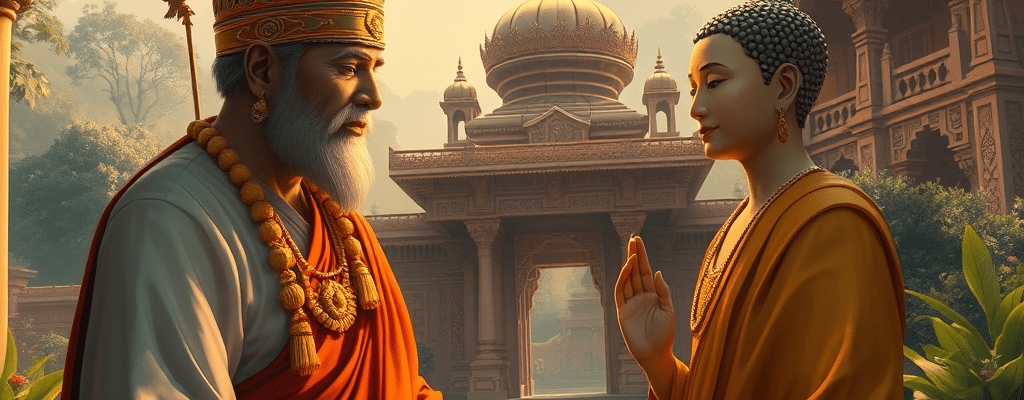
After attaining enlightenment, the Buddha did not keep his realization to himself. He shared the path he had discovered with others, beginning with just five former companions. From that small circle, the Sangha grew rapidly—within a short time, numbering in the thousands. This extraordinary expansion was made possible not only by the power of his teaching, but also by the simplicity and openness of the early monastic system, where any monk could admit new members into the Order.
The Buddha attracted people from all walks of life. Renowned ascetics such as the Kassapa brothers joined him. Youths from aristocratic families left behind privilege and comfort to follow him. Even King Bimbisara, ruler of a neighboring kingdom, became a devoted supporter and disciple. News of the Buddha’s influence and growing community spread quickly across the region.
It was inevitable that these stories would reach Kapilavatthu—and King Suddhodana.
Upon hearing of his son’s achievements, King Suddhodana invited the Buddha to return home. What motivated this invitation? Pride, perhaps. After all, here was a former crown prince who had once renounced palace life, abandoned royal duties, and wandered homeless in search of truth. To an outsider—especially one unfamiliar with Buddhist values—would this not appear irresponsible? Even foolish? A privileged heir who could not endure the pressures of palace politics, choosing instead to walk away from everything he was entitled to?
Yet now, that same son had been recognized as a fully awakened Buddha by kings and seekers alike. He commanded respect, taught with authority, and led a vast community of followers. Perhaps King Suddhodana felt that the time had come for the kingdom to see what his son had become.
Or perhaps the invitation had nothing to do with pride at all.
Perhaps it was simply a father missing his son.
Perhaps it was the quiet longing of a parent who had not seen his child for years, hoping for a reunion. Maybe, deep in his heart, King Suddhodana still wished that Siddhartha would return to palace life—this time not as a rebellious prince, but as a successful and respected figure who had “proven himself” to the world.
The scriptures do not tell us what King Suddhodana felt. And in that silence, we are given the freedom to imagine.
What we do know is this: King Suddhodana was not just any father. He was a king, a man of power and status, whose hopes and expectations had been firmly placed upon his eldest son. Siddhartha was meant to inherit the throne, to continue the lineage, to fulfill the dreams of generations. Instead, he chose a path that defied those expectations entirely.
This tension is not unique to ancient India. It is deeply human—and deeply familiar.
How many times in our own lives have we disappointed our parents because we desired something different from what they envisioned for us? And when we become parents ourselves, how often do we watch helplessly as our children make choices that frighten us—choices we fear may lead them toward suffering or failure?
This part of the Buddha’s story offers us a profound lesson.
Differences in life do not have to lead to hostility or resentment. They can become opportunities for learning, adaptation, and transformation. In this story, King Suddhodana eventually became a disciple of his own son. For a king to regard his child as his spiritual teacher requires extraordinary humility and openness. The shift in perspective—from authority to student, from disappointment to respect—is remarkable.
From respect, faith arose.
By letting go of past expectations and embracing the reality before him, King Suddhodana created space for a new relationship to form—one not defined by obligation or regret, but by understanding and reverence.
We may not be the Buddha, but our relationships with family are also constantly evolving. A dependent child may one day become a caregiver. A learner may become a teacher. A provider may become the one who receives care. Through these shifts, we come to understand the many roles we inhabit over the course of a lifetime.
Perhaps this is what gives life its depth and meaning.
And perhaps the most important lesson we can carry with us is this: to be prepared for change—not with resistance, but with openness. Because when we allow relationships to transform, we allow ourselves to grow along with them.
May all be well and happy.
Categories: Articles, Shakyamuni Buddha
 I am just an ordinary guy in Singapore with a passion for Buddhism and I hope to share this passion with the community out there, across the world.


 Bodhi-Bowl