
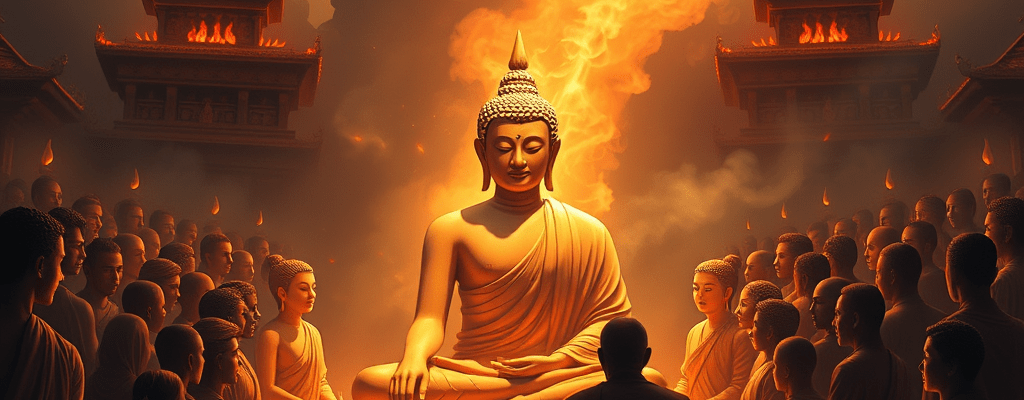
After guiding the one thousand fire-worshippers to attain Nirvana, the Buddha proceeded to Rājagaha, accompanied by the same one thousand Arhats. His purpose was to fulfill a promise made to King Bimbisara, who had once requested that the Buddha grace his city should he attain enlightenment.
During a previous encounter, King Bimbisara had been deeply impressed by Sramana Siddhartha’s serene bearing and had even offered him half his kingdom. Upon learning that Siddhartha was a crown prince who had renounced the world to seek the Truth, the king beseeched him to visit Rājagaha after achieving his goal.
King Bimbisara was therefore delighted by the Buddha’s arrival and arranged for his nobles to join him in welcoming the enlightened one. When they saw the Buddha accompanied by the famous Kassapa brothers, a doubt arose in their minds: Who was the teacher and who was the disciple? Had the Buddha converted the Kassapas, or had the Kassapas taken Siddhartha in as their own follower?
Perceiving their doubt, the Buddha addressed Kassapa directly with a question.
“O dear son, Kassapa, you who are a great teacher in your own right, why did you give up your fire-worship? I ask you, Kassapa, what made you abandon this ancient practice?”
Kassapa replied, “Exalted Buddha, the teachers of sacrificial rituals taught that through sacrifice, one can enjoy the five sense-pleasures: sight, sound, smell, taste, and touch, as well as the company of women. But having seen and known well that these sense-pleasures serve only as defilements of the five aggregates, I no longer find joy in offering such sacrifices. I have lost all delight in the daily practice of fire-worship.”
In essence, Kassapa was explaining that sacrificial worship was meant to secure pleasurable delights in this life. But he had realized that such pleasures are merely defilements that trap a being in endless rebirth. Therefore, the practice no longer held any meaning for him.
This is also why a Stream Enterer, or Sotapanna, no longer feels compelled to participate in rituals and ceremonies. Having realized the essence of non-self, there is no purpose in praying for something since there is no “I”.
The Buddha then pressed further, “Dear son Kassapa, if your heart finds no delight in the five sense pleasures or in women, what in this world of Devas and humans does delight you? Answer me that, Kassapa.”
Kassapa responded, “Exalted Buddha, it is because I have distinctly perceived Nibbāna—
- which has the characteristic of peace,
- which is free from the four attachments to wife, children, property, and wealth,
- which cannot be made known by others but must be realized through the path developed by oneself,
- which is not subject to change, being free from birth, old age, and death, and
- which is forever free from the lust for life and attachment to existence.
It is for this reason I no longer enjoy offering sacrifices. It is for this reason I no longer take delight in the daily practice of fire-worship.”
Following this profound reply, Kassapa rose from his seat, prostrated to the Buddha, and declared him the teacher. To physically demonstrate his mastery and the power of the Dhamma, Kassapa then levitated seven times, each ascent reaching a greater height. At the end of the seventh levitation, he approached the Buddha and prostrated once more.
This display of supernatural ability, combined with Kassapa’s heartfelt declaration, utterly dispelled all doubt and firmly established the faith of King Bimbisara and his entire entourage in the Buddha.
In that manner, they are finally receptive to Buddha’s teachings and Buddha taught them the Dharma. Consequently, they attained the 1st level of enlightenment and became Sotapannas.
It is important for us to note the importance of receptiveness when we listen to Dharma. This receptiveness is not based on blind faith but yet, it is also open to transformational information.
May all be well and happy.
Categories: Articles, Shakyamuni Buddha
 I am just an ordinary guy in Singapore with a passion for Buddhism and I hope to share this passion with the community out there, across the world.


 Bodhi-Bowl