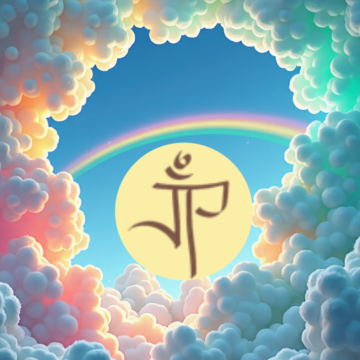

This is another personal take on the age-old practice of offering our world—commonly known as the Mandala Offering.
Rooted in Vajrayana Buddhism, this practice can, at first glance, seem baffling. The traditional verses speak of Mount Meru, the four continents, and other elements of an ancient cosmology in which the Earth is flat. As a beginner, I remember grappling with the strangeness of these concepts, struggling to make an offering of a world that felt completely foreign to me.
That struggle lingered. Every Sunday, I would chant the verses and wrestle with an inner conflict—religion versus science, ancient wisdom versus modern knowledge. More than once, I caught myself thinking, Just believe, just believe. Then one day, someone asked Rinpoche, “Can we visualize the Tibetan seed syllables in Romanized alphabets? Because we don’t know Sanskrit or Tibetan.” And he answered, “Sure! Why not? It’s the heart that counts.”
That was the moment my Mandala Offering became both modern and heartfelt.
At its core, this practice is about offering what is most precious to us to the Buddha. It is a skillful method rooted in devotion. But if we approach it with a transactional mindset—offering something with the hope of gaining something in return—then we’ve missed the point entirely.
When we engage in this practice with sincerity and a true intention to cultivate renunciation, it can become deeply transformative.
In offering our world, we are asked to reflect: What truly makes up my world? What do I hold dear? For ancient practitioners, this might have included kings, queens, ministers—symbols of their national identity. The practice was about letting go of that identity. In today’s context, if you are American, perhaps it’s about offering up the pride and attachment tied to that identity. And let’s be honest—few are ready to truly let that go.
When our prayers and chants become personal, they gain power and become dynamic.
For me, the Mandala Offering is about surrendering all that defines me—my family and community, my national identity, my race and ancestry, my qualifications, my health, my job title, even the Earth, the solar system, and of course – my body and entire state of being. This insignificant “me” is part of the mandala too. After all, isn’t that how we perceive our modern world? And these things are precious. Just imagine losing them all. Who would you be then? Could you sincerely offer them—and truly not mind if the Buddha took them all?
Strangely enough, it is precisely these cherished attachments that trap us. But in the rare moments when the mind stops grasping at them, there is a brief, luminous glimpse of spacious freedom—just before the habitual mind rushes back to reclaim everything it had just offered.
May all be well and happy.
Categories: Articles
 I am just an ordinary guy in Singapore with a passion for Buddhism and I hope to share this passion with the community out there, across the world.


 Bodhi-Bowl