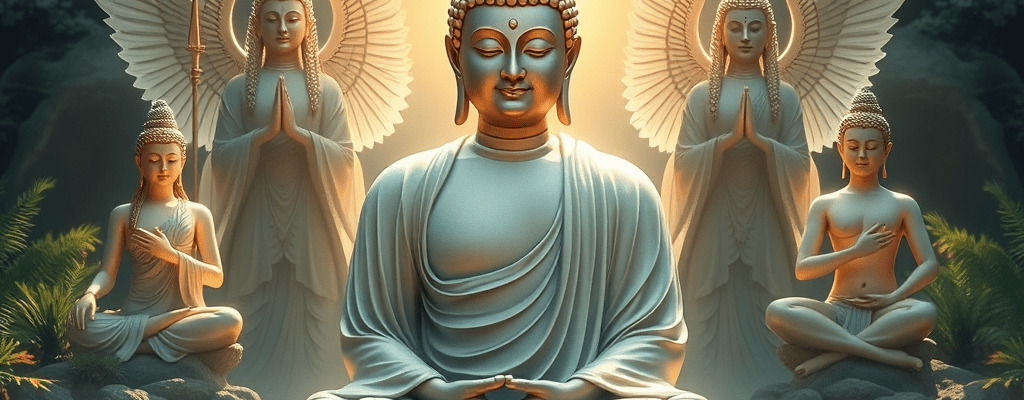
The ninth honorific of the Buddha, Śāstā deva-manuṣyāṇām—Teacher of gods and humans—is my personal favorite. It beautifully encapsulates the Buddha’s universal role as a guide, transcending divisions between celestial beings (devas) and humans.
In Buddhism, devas are heavenly beings residing in various realms, each with its own unique characteristics and rulers. Unlike in other traditions, devas are not considered creators of the universe or arbiters of individual fate. They are simply another type of sentient being, albeit one with exceedingly rich positive karma. A striking example is the story of Prince Siddhartha’s loyal horse, Kanthaka, who was reborn as a deva—a testament to the intricate workings of karma.
What makes this honorific resonate with me is its universal relevance. Buddhism teaches that every realm of existence—whether human or celestial—is marked by its own imperfections, leading to unhappiness and suffering. Even devas, with their great fortune, are not exempt from these truths. This shared condition connects all sentient beings, emphasizing our common struggle and the Buddha’s unifying role as the one who teaches the path to true happiness.
The Buddha’s teachings, particularly the Noble Eightfold Path, offer practical methods for cultivating wholesome actions, speech, and thoughts. His message transcends species and realms, making him a teacher not just for humans but for devasas well. This perspective fosters a sense of kinship among all beings, reminding us that we are all fellow students striving for the same goal. In essence, to be as “glorious” as a deva, one need only cultivate wholesomeness.
This holistic view has profoundly shaped my approach to spirituality. As Buddhists, we recognize the value of virtues like kindness, compassion, wisdom, and peace—principles shared across many traditions. This shared foundation allows us to engage respectfully with people of other faiths, pray alongside them, and celebrate these universal values together.
However, I must confess that my understanding of this honorific evolved over time. As a teenager, I interpreted it quite differently. Back then, I saw the Buddha as more powerful and superior to all other gods and goddesses. This belief gave me a sense of pride and superiority, which, in hindsight, only fed my ego—a significant barrier to enlightenment. Yet, that sense of superiority also provided much-needed confidence during an insecure phase of my life.
This experience taught me an important lesson: it’s essential to regularly reflect on how our interpretation of the Buddha Dharma shapes our mindset and personality. Does it help us grow in humility and compassion, or does it inflate our ego? Our perspectives on the teachings are not static—they evolve as we practice, learn, and mature.
Today, I cherish the idea that the world can be united by focusing on shared values: love, kindness, compassion, and peace. These principles transcend boundaries and connect us all, regardless of our background or beliefs.
May all beings be well and happy.
Categories: Articles
 I am just an ordinary guy in Singapore with a passion for Buddhism and I hope to share this passion with the community out there, across the world.


 Bodhi-Bowl