The seventh honorific of Buddha is Anuttarā—meaning “unsurpassed hero” or “undefeatable victor.” This naturally raises the question: “Which battles did the Buddha win?” The answer may surprise you—inner battles. However, such a response often leaves people puzzled, asking, “Inner battles? What does that even mean?”
Let’s explore this through the lens of greed and desire, as these are easier to grasp. Imagine we deeply desire something or someone. When our desires go unfulfilled, we often feel stress and unhappiness. Mental suffering, as we all know, is profoundly unpleasant. So, how can we stop this pain?
The answer seems deceptively simple: by letting go of our desires. If we could master our thoughts and release our cravings, we could end our mental suffering immediately. Wouldn’t you agree this is the simplest, most productive, and cost-effective solution?
But here’s the catch—how many of us can simply switch off our desires? For most, fighting this inner battle feels impossible.
This is where the Buddha’s victory stands out. By completely and permanently letting go of craving, desire, and attachment, he achieved a state of unshakable peace. That is why he is celebrated as the Anuttarā, the undefeatable hero.
The other aspect of craving is aversion, and the counterpart of desire is hatred. When we desire something, it naturally implies that we reject its opposite.
To complicate matters further, our minds are often clouded by ignorance, and society tends to celebrate this ignorance as if it were wisdom. Let me explain. Take, for example, a game of chess.
In chess, the goal is to outsmart your opponent and win. If you can anticipate their moves, you’re praised as a strategist with great foresight. However, the foresight of ordinary beings is often nothing more than fearful speculation. We imagine how our opponent might harm us and base our actions on these imagined scenarios.
Now, consider what happens when we bring this fear-driven mindset into the real world. We start planning for the worst, imagining how others might harm us, and taking actions to counter these imagined threats. What if we possessed tremendous power? Would we be tempted to eliminate our perceived threats entirely, thinking it would free us from worry? But here’s the problem: everyone else is capable of the same fearful imagining and counter-planning. The result? Chaos.
So, can we stop this cycle? It’s easier said than done.
The Buddha, however, achieved what seems impossible: he eliminated all such cravings, aversions, and ignorance from his mind. This is why he is celebrated as the unsurpassed hero. Why? Because no one had accomplished this before him.
Yet, even when we simplify this concept, some people struggle to grasp its significance. To them, the idea of battling oneself doesn’t seem as heroic as fighting external foes.
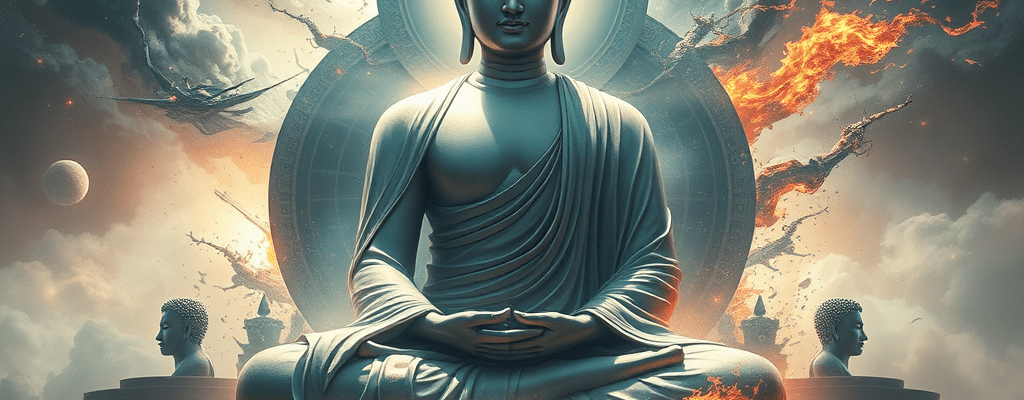
For such individuals, we can turn to the tale of the Buddha’s victory over Mara’s armies. When all other gods fled in fear, unable to stand against Mara’s formidable forces, the Buddha sat steadfast, unmoved, and ultimately triumphed. This story symbolizes his inner conquest—a battle far more challenging than any external war.
May all be well and happy.
Categories: Articles
 I am just an ordinary guy in Singapore with a passion for Buddhism and I hope to share this passion with the community out there, across the world.


 Bodhi-Bowl