
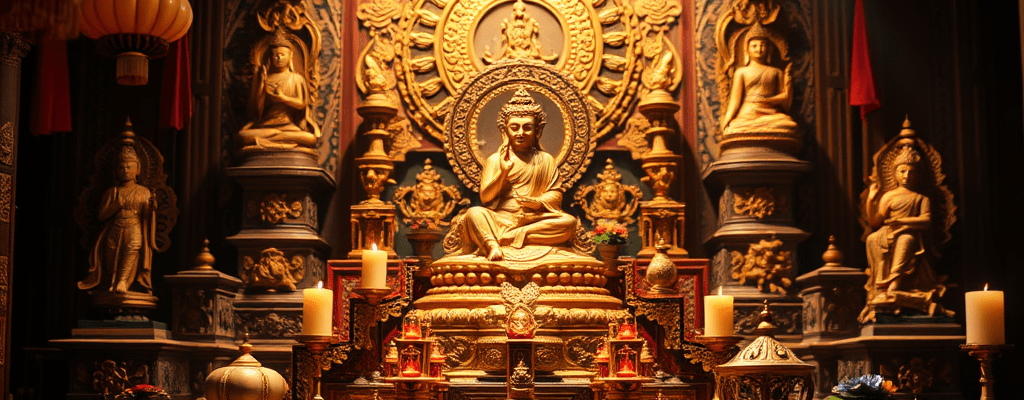
Vajrayana is a form of Buddhism that evolved from Mahayana, it emphasize esoteric teachings, rituals, and meditative practices that is supposed to accelerate enlightenment. The word Vajra is associated with Diamond (indestructible quality) and Thunder/lightning (swift and powerful quality), whereas the word yana means a vehicle that brings you to the desired destination.
Therefore, Vajrayana means an indestructible and swift vehicle / method to bring us toward Enlightenment.
Scholars suggest that Vajrayana Buddhism emerged several centuries after the Parinirvana of Shakyamuni Buddha. It developed as a response to the social, cultural, and religious challenges that Buddhism faced in India. In the Pali Canon, Shakyamuni Buddha advises his disciples to avoid certain “lowly arts” such as reciting mantras, performing rituals, and consulting the stars. Yet, in contrast, Vajrayana Buddhism enthusiastically embraced these very practices. Therefore, Buddhists who follow the Pali Canon are qucik to brush off Vajrayana Buddhism as a deviant development. Not the Buddha’s words
Advocates of Vajrayana Buddhism offer a different perspective on Vajrayana’s origins. According to their view, the Buddha taught Vajrayana as a secret method for attaining enlightenment, intended only for highly advanced students. In other words, it was privileged knowledge, accessible to a selected few. While other methods are thought to require many lifetimes of practice, Vajrayana Buddhism presents itself as possessing a unique, “secret formula” that promises Buddhahood within a single lifetime. I was attracted by this promise of quick enlightenment.
Consequently, I changed my approach to Buddhism from an anti-ritual person to one that embraces mantra and mudra with gusto.
I hope to share my personal journey and observation about Vajrayana practices from my perspective in these series of posts.
Associating with Vajrayana Deities – level 1
Vajrayana Buddhism includes a vast array of symbols, ritual implements, and Buddhist deities, each carrying its own profound meaning and purpose. I use the term “deity” here instead of “Buddha” or “Bodhisattva” because, for beginners, that’s often how we relate to these Buddhist spiritual beings.
Our understanding of enlightenment is limited; we don’t fully grasp what it truly means. Enlightenment often appears to represent a state of immense power, holiness, wisdom, and purity—an elevated, almost BEYOND divine presence embodying wholesomeness and goodness. Yet, it remains mysterious and beyond comprehension. We are taught that the Buddha transcended the heavens where gods reside. Therefore, for many beginners, Buddhist deities simply represents a spirititual presence that are higher or more powerful than any non-Buddhist ones.
This interpretation of enlightenment—and of the Buddha, Bodhisattvas, and arhats—is a natural one. Ancient Tibetan and Indian beginners likely held similar ideas, seeing enlightenment as a god-like state and viewing Buddhas and Bodhisattvas as deities who fulfill various wishes. For example, Amitabha Buddha is believed to guide followers to a Buddhist paradise, while Medicine Buddha is thought to have the power to heal illness.
In short, this approach to Buddhism is designed to welcome those who are drawn to worship and ritual more than meditation. However, it carries certain risks.
One common issue is that people often project their own personalities onto their chosen deities. A vengeful person might imagine their deity as similarly unforgiving, while someone inclined toward indulgence might see their deity as encouraging promiscuity. This can happen for several reasons:
- The teacher performing the empowerment did not provide clear guidance.
- Disciples may misunderstand or misinterpret the teachings.
- Practitioners may form incorrect conclusions on their own.
- The disciples may lack sufficient maturity or insight, and the teacher may be unaware of this.
As a result, I have encountered Vajrayana practitioners who justify harmful or indulgent behavior as a form of “wrathful enlightenment,” or “crazy enlightenment” which is a serious misunderstanding of the Buddha’s teachings. Instead of helping to tame and transcend greed, hatred, and ignorance, this misguided approach can end up magnifying them—precisely the opposite of what the Buddha intended.
So what would be a better approach? In my own opinion;
For some, studying scriptures feels impossible and torturous. So instead, we can work with their innate respect and even fear of the deity. They must chant the mantra a million times with focus and respect, knowing that failure to do so may result in unfulfilled wishes—or, in some beliefs, the deity’s wrath.
It’s essential to teach disciples to chant the mantra with undivided attention. This is how to honor the deity. Imagine inviting a president or king to your home, only to ignore them when they arrive—that would be a terrible transgression, right?
Similarly, when we chant a mantra, we believe the deity arrives, so we must not let our minds wander. Entertaining other thoughts while chanting would be disrespectful. Instead, we must focus entirely on the mantra, shutting off all other thoughts, including our own desires. This is the proper way to show respect and devotion.
This practice isn’t about reaching a numerical goal but rather about developing quality mental focus. If we become distracted during the mantra, it doesn’t count, and we repeat until we can chant without distraction. In short, to honor the deity and have our prayers fulfilled, we must let go of all other desires and focus fully. I believe this is a skillful way to encourage people to practice mindfulness and strengthen their mental discipline.
Additionally, it would be beneficial for teachers to establish special commitments from their students—personal vows that reflect a meaningful sacrifice. For example, a student might vow to refrain from alcohol except on special ritual occasions, abstain from promiscuity except with a spiritual consort, offer a word of encouragement to someone each day, or make an offering to another person daily.
Since this approach targets individuals who may be more inclined to worship mountain gods or practice animal sacrifice—and who may have little patience for studying concepts like the Four Noble Truths—these practices should be straightforward and easy to follow. It is much like guiding a rebellious child.
Naturally, the teacher must know their student well to design commitments that suit the student’s mental and moral growth. For example, if a student struggles with generosity, the teacher might encourage a daily offering as a personal vow to develop charity. In this way, each vow is carefully tailored to the individual’s growth and is strictly private. Just as one would not share a psychiatric report with others, the commitments made between a Vajrayana teacher and student are similarly confidential.
This kind of relationship underscores the intimacy and trust essential between a Vajrayana teacher and student.
This is the foundational practice, or “level one,” that students must follow and commit to. At this stage, the deity is visualized as an external presence embodying certain values or principles. Worship involves observing ritual commitments that serve as training for our actions, speech, and thoughts. Through this process, students gradually align themselves with the qualities represented by the deity.
When we do this successfully, greed, hatred and ignorance will slowly lose its influence over our minds.
May all be well and happy.
Categories: Articles
 I am just an ordinary guy in Singapore with a passion for Buddhism and I hope to share this passion with the community out there, across the world.


 Bodhi-Bowl