After Brahma Sahampati departed, the Buddha reflected, “Who should I share my teachings with first? Who will quickly grasp the Dharma?”
His thoughts turned to Alara Kalama, his former meditation teacher.
“Alara would be the ideal candidate,” the Buddha considered. “His wisdom is unclouded by worldly desires.”
But a divine being whispered to the Buddha, “Alara Kalama passed away seven days ago.” Using his omniscience, the Buddha confirmed this and saw that Alara had been reborn in the formless realm. Brahmas in this realm dwell in deep meditation bliss, isolated and incapable of hearing the Dharma.
Next, the Buddha thought of Udaka Ramaputta, another former teacher. Yet Udaka, too, had passed and was reborn in the formless realm.
Then, the Buddha remembered the Five Ascetics who had supported him during his six years of ascetic practice in the Uruvela Forest. “I’ll teach the Dhamma to them.”
With his divine vision, the Buddha saw the ascetics residing in the Deer Park, near Varanasi. Determined, he resolved to make the 250-kilometer journey on foot. Some might wonder, “Why didn’t he simply fly there, especially after walking on air for a full week?”
The answer lies with a man named Upaka.
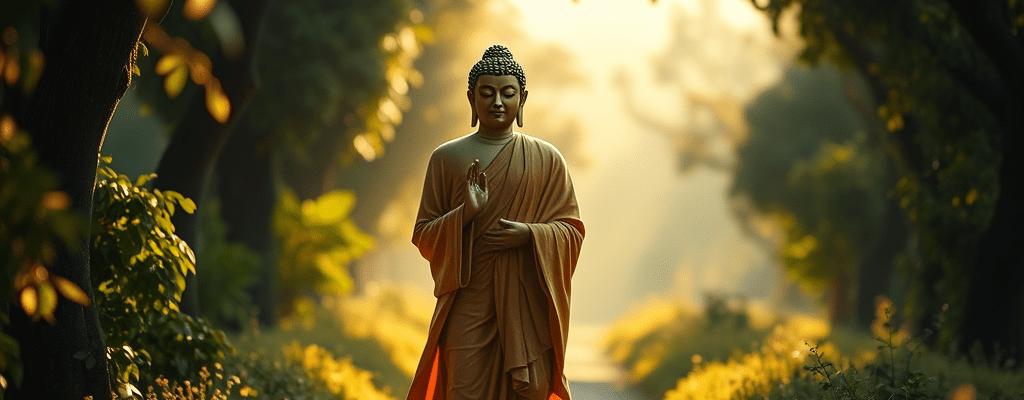
As the Buddha journeyed toward the Deer Park, he encountered the wandering ascetic Upaka, who, noticing the Buddha’s radiant appearance, approached him and asked, “Friend, your eyes, ears, nose, tongue, body, and mind are so clear; your complexion is bright and glowing. Under which teacher have you gone forth? Whose teachings do you follow?”
The Buddha responded in verse:
“I have mastered all Dhammas in the three worlds and possess perfect knowledge of them all.
I am free from all defilements—greed, wrongdoing, delusion—and have abandoned all.
I am liberated from craving, firmly established in Nibbāna.
Who could I name as my teacher, when I have realized the truth on my own?”
Buddha continued:
“I have no teacher, nor is there anyone equal to me. In this world, with its devas and sentient beings, there is no one who can compare to me in purity and wisdom.”
“I am the Arahant in this world, the one deserving of great veneration.
I am the incomparable Teacher, the fully enlightened Buddha.
I have extinguished the fire of defilements and reached perfect peace.”
“I am going to the Deer Park near Varanasi to set in motion the Wheel of Dhamma. I will sound the Deathless Drum for the devas and humans, who, like the blind, wander in darkness without wisdom.”
Upaka, impressed yet uncertain, replied, “Friend, if what you claim is true, you must indeed possess infinite wisdom and have conquered the forces of Māra.”
The Buddha affirmed:
“Those like me, who have attained the knowledge of the extinction of defilements and abandoned unwholesome qualities, are called Jinas—Conquerors. I, too, am a Jina, for I have triumphed over all evil.”
Acknowledging the Buddha’s words, Upaka nodded and said,
“What you have said may be true.” Then, taking another path, he continued his journey toward Vaṅkahāra.
Though uncertain in that moment, this encounter planted a seed in Upaka’s heart that would later lead him to look for Buddha and become his disciple.
Indeed, the Buddha had taken the journey on foot to meet him, knowing that Upaka possessed the extraordinary merit that would lead him to the Dhamma in due time.
This encounter is important because Buddha was explaining himself to an ordinary man for the first time. In some version, the dialogue was summarized as Upaka inquiring if Buddha was man or God, with Buddha replying that he is neither, but a Buddha.
And if we ponder deeper, Upaka was obviously spiritual enough to sense something unique about Buddha. Yet upon listening to Buddha’s self-introduction, Upaka literally said “yeah, right” and walked away.
This brings into mind why Buddha decided to teach his 5 companions first, I believe they would be more receptive to listening to Buddha because he wasn’t a stranger. In other words, they would be more receptive.
Buddha’s reply was also incorporated into a praise in both Pali chanting and Chinese Chanting (如来十号). It can be used as a meditation tool to contemplate Buddha or recall Buddha (念佛)
Discussion
Reflect on a common theme in the story; The readiness or conditions to receive Dharma. How does this apply to us?
Discuss and reflect upon Buddha’s reply. (Note: He said he is an Arahant and also said he is a Buddha)
Categories: Articles, Shakyamuni Buddha
 I am just an ordinary guy in Singapore with a passion for Buddhism and I hope to share this passion with the community out there, across the world.


 Bodhi-Bowl