
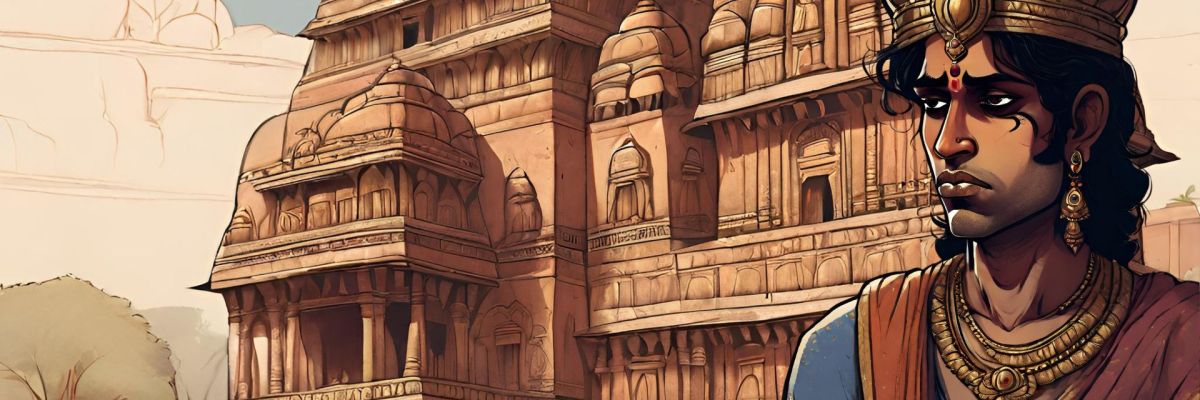
Although Siddhartha was troubled by the sight of old age, that was soon over shadowed by secular pursuits after three months. King Suddhodana had ordered double entertainments for Siddhartha and in addition to that, there were work and family to keep him occupied.
Siddhartha was keenly aware of the nation’s expectations upon him. The onus was on him to demonstrate his capabilities for the duties befitting a king. A conscientious and dutiful son, Siddhartha aspired to surpass these expectations and prove himself as a worthy monarch. Consequently, he requested a second tour of the kingdom that he had never seen.
For this second royal inspection, King Suddhodana commanded an increase in guards. However, Siddhartha’s abrupt conclusion of the first royal inspection fuelled rumours and disappointment among the affluent citizens who had fervently welcomed the prince. Unaware of the psychological turmoil Siddhartha experienced, powerful families perceived the premature end of the royal parade as a snub. Many decided to abstain from participating in this subsequent procession.
With heightened security and families indoors nursing their perceived grievances, the second inspection unfolded in a somber atmosphere. Prince Siddhartha traversed the less-than-welcoming affluent neighborhood of Kapilavastus. As the streets remained relatively deserted, the guards gradually eased their vigilance. In due course, the time for Siddhartha’s return arrived, prompting the royal entourage to make their way back to the palace.
Unbeknownst to many, celestial beings known as devas were observant participants. At the corner where the royal procession turned toward the palace’s main road, a deva manifested in the form of a sick man. In that fleeting moment, both Siddhartha and Channa beheld the agonizing sight of a man gasping for breath, writhing in pain, with clothes stained by vomit, urine, and excrement, and pus oozing from open boils.
“Did you witness that, Channa? What happened to that man?” inquired Siddhartha.
“My lord, that man is afflicted by a severe illness,” responded Channa.
“What do you mean, Channa? Can illness bring about such agony? I have been unwell before, but never have I experienced such horrors.”
“My lord, illnesses manifest in diverse forms. Some are far more devastating than what we witnessed.”
“Are you suggesting I could succumb to such an affliction? Even Yashodhara?”
“Yes, my lord. Sickness is indiscriminate. It can befall any of us, and the nature of the malady remains uncertain.”
Siddhartha lapsed into a profound silence, his countenance reflecting the melancholy realization of life’s inherent vulnerability.
Points for discussion
Our busy life makes it difficult to notice the predicament that we are in. Namely, the inevitable decline and breaking down of health and life. Most of us welcome these distractions because it allows an escape from the harsh reality of our mortal existence. Although it is a way of dealing with the associated distress, do you think it is the best method? What if Siddhartha could be easily distracted like us, would there still be a Buddha?
There is a tendency for us to think the worst about others because we do not want to be taken for a fool. Like the royal and affluent families, none of us would bother to know what is behind those happy faces we see everyday. Perhaps, there is no way for us to find out. But is it truly the wisest approach to think the worst of others in our habitat tendency to protect ourselves?
May all be well and happy.
Categories: Articles, Shakyamuni Buddha
 I am just an ordinary guy in Singapore with a passion for Buddhism and I hope to share this passion with the community out there, across the world.


 Bodhi-Bowl