
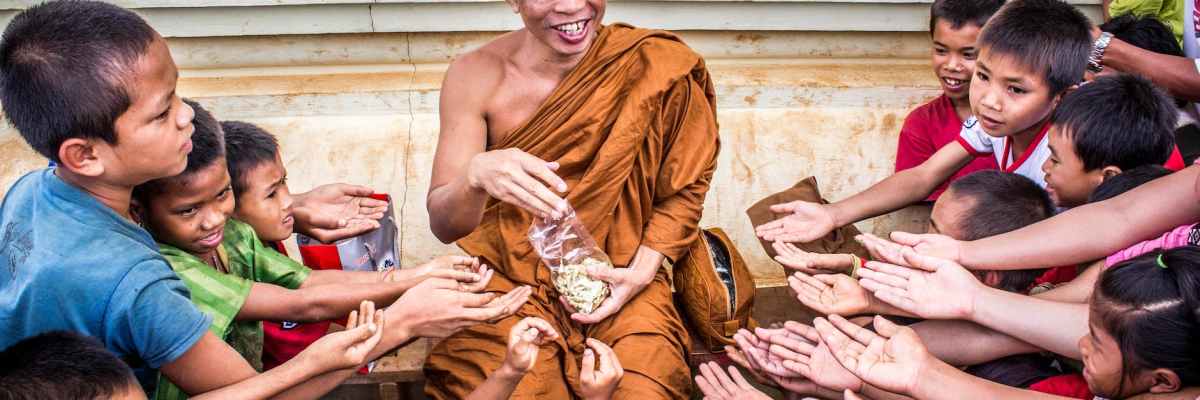
One of the preferred spiritual practices of Buddhists is Dana. Dana is a Sanskrit word and it means giving. In short, it is an act of charity whereby one gives something out of goodwill towards another.
The practice of giving is an art itself and without knowledge, the merits or positive karma generated from our giving will diminish significantly.
During the Buddha’s time, Buddhists offered food and permissible requisites of living to the monastic communities. However, this gradually transformed into the practice of giving money.
Giving money is convenient and modern people prefer hassle-free, commitment-free practices. To complicate matters, huge monasteries with high running costs continue to mushroom all over the world. Each of these establishments needs funds and competes for donations by providing spiritual services or goods. It is almost like a business enterprise.
With all these observations, let us explore what the Buddha taught about Dana. For our 1st stop, let us visit the Velama Sutta (AN 9:20)
On one occasion the Blessed One was staying near Sāvatthī in Jeta’s Grove, Anāthapiṇḍika’s monastery. Then Anāthapiṇḍika the householder went to the Blessed One and, on arrival, bowed down to him and sat to one side. As he was sitting there, the Blessed One said to him, “Householder, are gifts still given in your family?” Anathapindika: “Gifts are still given in my family, lord, but they are coarse: broken rice cooked with bran, accompanied by pickle brine.”
Anathapindika has been mentioned numerous times in my blog. He was ultra-rich and a philanthropist during the Buddha’s time. This sutta started off by describing the meeting between Buddha and this staunch lay follower. It is interesting to note the following from this paragraph.
- Buddha asked if Anathapindika was still practicing dana or charity. (Do you find yourselves asking, “Shouldn’t Buddha already know the answer since he is omniscience?”)
- Since Anathapindika was ultra-rich, why is he offering “poor” quality gifts?
The idea or concept of an omniscient “Higher being” (a.k.a God/ goddess) constantly watching over us is nothing but a romantic fantasy invented by people. One of the major misunderstandings in Buddhism is that Buddhists imagine The Buddha or Bodhisattva to be the replacement for God/goddess from ancient religion. So they pray to Buddha or Bodhisattva just like they used to pray to Gods/goddesses.
Moreover, Shakyamuni Buddha recalled all his past lives upon enlightenment and he remembered living as God or Deva in some of his previous existences too. And you know what? The Gods/Goddesses are not always looking in our direction because they are too busy enjoying themselves. As one master wisely explained, “Do you constantly travel to a dung pit to watch over the dung beetles?” To the celestial realm, the human world stinks of selfishness, ill will, jealousy, greed, etc. They have better entertainment than to look at us.
While certain Buddhist texts portray Shakyamuni Buddha as having supernatural powers, a deeper exploration reveals that, for the most part, the Buddha led a life of humility and simplicity. He chose to convey his wisdom as an ordinary teacher, inspiring us to engage in thoughtful contemplation and cultivate wisdom for our own betterment.
In this sutta, we observe the Buddha embodying the characteristics of a humble teacher who genuinely cared about Anathapindika’s well-being. Imagine Anathapindika’s arrival at the monastery one late morning, warmly greeting the Buddha as both a teacher and a friend. Their conversation began in a relatable manner, much like how any of us would initiate a friendly exchange.
To understand the context of this meeting, we need to know that Anathapindika almost went bankrupt at one point in time!
If this sutta records a conversation between Buddha and Anathapindika at that period of time, Then it would totally make sense.
This leads to a 3rd question. If everyone knew that Anathapindika was facing financial hardship, why was Buddha still asking about Anathapindika’s philanthropic practices? Shouldn’t Buddha be advising Anathapindika to “slow down”? I mean, that is logical right?
The Theravada Suttas are known to be very concise and short, but when we examine them with some background information in mind, they become more interesting. I’ll let you muse over this for the time being and will continue in my next post.
Meanwhile, do discuss with your fellow dharma friends if you have any. Dharma discussion can be very uplifting and meritorious if done correctly. Have fun!
May all be well and happy.
Categories: Articles
 I am just an ordinary guy in Singapore with a passion for Buddhism and I hope to share this passion with the community out there, across the world.


 Bodhi-Bowl