
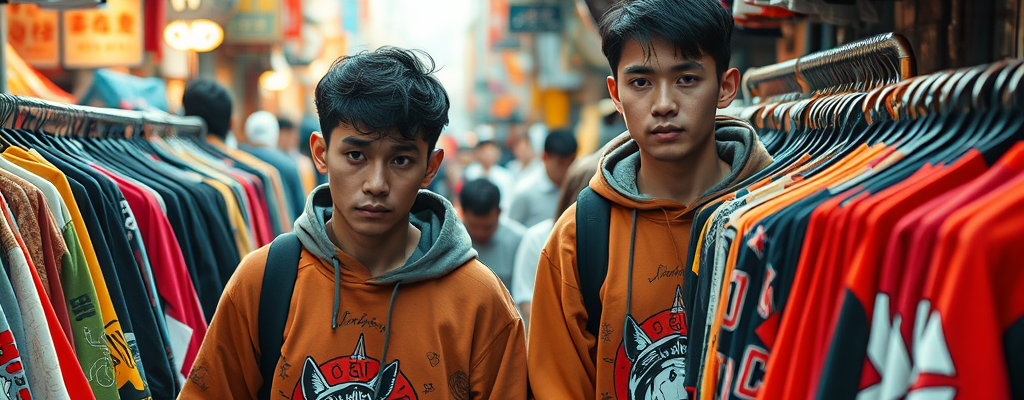
It was Day 9 of my vacation in Guangzhou — the kind of day when the novelty of travel has worn off and reality quietly settles in.
The entire day was dedicated to shopping in a wholesale district reserved specifically for men. Endless walking. Mall after mall. Level after level. Shop after shop. The mission: to hunt down unique, fashionable streetwear at unbeatable prices.
At first, it felt exciting — like a treasure hunt.
But very quickly, the treasure began to look suspiciously identical.
Row after row of clothing that seemed to come from the same factory, cut from the same cloth, styled with the same oversized silhouettes and loud graphics. The deeper we walked into the maze of commerce, the more it felt like déjà vu on repeat. What was once exploration slowly turned into obligation.
Still, my partner remained determined. Somewhere in this sea of sameness, he believed, was the one rare gem worth the entire journey.
I didn’t mind plodding along. I tried to look interested. I nodded at jackets, lifted shirts from racks, squinted thoughtfully at price tags.
But secretly, I was counting down to mealtime.
To sit down.
To rest my aching legs.
To taste proper Cantonese cuisine in the land where it was born.
That small hope became my emotional anchor for the day.
Unfortunately, wholesale districts are not culinary destinations. They are industrial ecosystems. Everyone was there for business — buyers stocking their retail shops, negotiating bulk prices, calculating margins. Food, if available, was functional. Quick noodles. Fast rice. Eat and go.
When I expressed my enthusiasm for eating properly — for exploring Cantonese food while in Canton — I was met with a disapproving remark:
“Why do you keep eating and ordering so much food?”
It landed heavier than expected.
Apparently, having meals at standard hours was indulgent when the day’s true purpose was shopping. Ordering three dishes to share between two people was excessive; when a single bowl of noodles could be consumed in ten minutes — leaving more time to resume the hunt.
That was when I realised how easily travel exposes differences.
Different appetites.
Different priorities.
Different definitions of what makes a day “well spent.”
And when preference clashes with expectation, even small remarks can feel sharp. Many friendships have quietly unravelled during trips — not because of major betrayals, but because of accumulated irritation, fatigue, and poorly timed words.
So I told myself: take a step back.
Reprogram.
Lunch can be at 3pm.
Dinner — undecided.
Be content.
Flow along.
Better to bend than to argue in broad daylight in a foreign land.
But beneath that outward calm, another voice whispered:
Why must I always be the one to retreat?
Do my wants not count?
Is it wrong to desire good food?
Even calling it “desire” felt suspiciously Buddhist — as if wanting anything at all required scrutiny.
Those background thoughts made neutrality difficult. Hurt has a way of leaking into tone, into facial expressions, into silence.
Yet something important happened.
Instead of reacting immediately, I held back.
Not suppressing — but pausing.
I allowed the day to unfold. We walked. And walked. And walked some more. The “treasure” remained elusive. The joy of shopping gradually dissolved into something mechanical — a zombie march through fluorescent corridors. Jaded eyes scanning racks. Tired legs advancing automatically.
I recognised that look on his face. That was how I felt earlier.
Eventually, when exhaustion softened the sharp edges of determination, there was space to talk.
I shared how I felt — not accusingly, but honestly.
And in that moment of sharing, I self-reflected and saw something clearly.
His relentless search for the perfect bargain was not so different from my relentless search for the perfect meal.
Both were forms of wanting.
Both were forms of hunting.
Both carried the risk of excess and disappointment.
The desire for the best deal can turn shopping into suffering.
The desire for the best food can turn appreciation into overindulgence — bloated stomachs and long queues included.
Different objects. Same mechanism.
When we finally spoke with measured calm instead of reactive heat, compromise became possible. It wasn’t dramatic. No grand apology. No cinematic reconciliation. Just understanding.
And that initial act of holding back — that refusal to lash out — created the space for cordiality.
I realised something quietly powerful that day:
The spiritually mature one often has to take the first step back.
Not because they are weaker.
Not because their needs are smaller.
But because they understand the cost of escalation.
Meditation is not proven in the meditation hall.
It is proven in wholesale malls at 3pm when you are hungry and irritated.
Peace does not descend from the sky.
It is initiated — often by the one who decides not to react.
In that sense, perhaps being “the one who retreats first” is not a loss.
It is leadership. A determination that states, “Today shall be a peaceful day”
In our small circles — friendships, partnerships, travel companions — someone must become the catalyst for peace. If our practice means anything, it must show up here: in aching legs, in unmet expectations, in ordinary disagreements about noodles and jackets.
Day 9 in Guangzhou did not give us the ultimate streetwear bargain.
But it did offer something rarer:
A reminder that every desire — whether for fashion or food — can quietly become suffering if left unchecked.
And that sometimes, the greatest souvenir we bring home is not what we bought, but how we learned to respond.
May all be well and happy.
 I am just an ordinary guy in Singapore with a passion for Buddhism and I hope to share this passion with the community out there, across the world.


 Bodhi-Bowl