
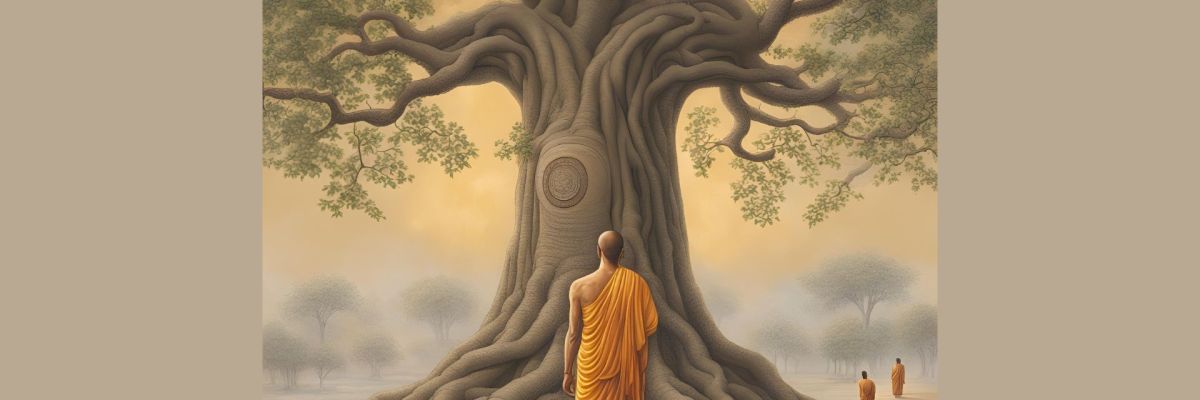
The Buddha’s Lesson in Humility and Nature
In the second week following his enlightenment, the Buddha stood in silent gratitude for seven days, meditating upon the Bodhi Tree without moving his eyes. This powerful gesture reflected his profound appreciation for the tree that had sheltered him during his quest for enlightenment. It is a moment that encapsulates the deep bond between Buddhism and nature and serves as a reminder of the Buddha’s character.
To truly understand the significance of this act, we need to revisit the Buddha’s triumph over Mara, the embodiment of desire and death. Mara’s terrifying onslaught was so intense that all other divinities fled in fear. Yet, the Buddha remained unshaken, achieving victory through his limitless virtues and profound wisdom. This triumph earned him the highest respect among the divinities, establishing him as the revered teacher of gods and men.
Despite his supreme status, the Buddha’s seven days of gratitude towards an inanimate tree illustrate a different kind of supremacy. Unlike the conventional notion of dominance and power, true supremacy in Buddhism is characterized by overcoming personal shortcomings and perfecting one’s virtues. This perfection naturally leads to humility and consideration towards others, including one’s environment. The Buddha’s silent appreciation of the Bodhi Tree exemplifies this ideal.
Understanding this quality of enlightened beings helps us discern that those who are self-serving, narcissistic, and desire to control others cannot be truly enlightened. Enlightened beings embody compassion, treating everyone with kindness and equality. This insight helps us distinguish genuine Buddhist masters from impostors.
The Influence on Buddhist Practice
The original practice of Buddhism is intimately connected with nature. Monastics lived among nature to escape the bustle of mundane activities, allowing them to focus better during meditation. Although the Buddha’s monastics numbered in the thousands, they maintained a disciplined respect towards the environment, living in forests, caves, and the wilderness.
The Buddha taught his disciples to respect trees and nature as sacred. Buddhist monks and nuns are forbidden from cutting trees, as trees provide habitat for many creatures. Harming a tree indirectly harms these beings. The Buddha also instructed them not to pollute rivers and streams, demonstrating his awareness of the impact of human actions on the environment. This concept in Buddhism is known as awareness of our Karma, meaning our intended actions.
The Buddha discouraged his disciples from harming the environment or living creatures in the name of Buddhism. He taught love and respect for all beings, both seen and unseen. This ethos encourages Buddhists to abstain from destroying nature, motivated by love and compassion.
Consequently, even though the Buddha’s disciples pursued the same supreme goal as the Buddha, they did not become haughty or careless. Like the Buddha, they remained conscious of their actions and strove to live considerately and harmoniously with others and nature.
From the moment the Buddha meditated in appreciation of a “simple” tree after Nirvana to his subsequent lessons to the monastics, he always displayed a sense of awareness and consideration towards others. The Buddha’s example of standing in gratitude before the Bodhi Tree serves as a timeless lesson in humility, respect, and the harmonious relationship between humanity and the natural world. By embodying these values, we honor the essence of enlightened living and contribute to a more compassionate and sustainable world.
Let us remember the Buddha’s example and strive to cultivate these values in our own lives.
May all be well and happy.
Points for discussion
- The Concept of True Supremacy in Buddhism:
- Explore the idea of true supremacy as described in the Buddha’s teachings. How does overcoming personal shortcomings and perfecting virtues differ from conventional notions of power and dominance? How can these principles be applied in contemporary life to cultivate humility and compassion?
- Buddhism’s Environmental Ethics:
- Examine the environmental teachings of the Buddha, such as the respect for nature, the prohibition against harming trees, and the importance of not polluting natural resources. How do these teachings align with modern environmental movements? What lessons can current environmental policies and practices learn from Buddhist principles?
Categories: Articles, Shakyamuni Buddha
 I am just an ordinary guy in Singapore with a passion for Buddhism and I hope to share this passion with the community out there, across the world.


 Bodhi-Bowl