

Siddhartha was filled with a profound sense of purpose upon waking up from the 5 great dreams. Convinced that this was the day he would attain enlightenment, he set out on his alms round earlier than usual. He soon arrived at the outskirts of the town, where a magnificent banyan tree stood in all its splendor. Recognizing the early hour, he chose to rest beneath its expansive canopy while waiting for the right time to seek alms in town.

Meanwhile, Sujātā, who was from a rich family, was making her way towards the same revered banyan tree from the heart of the town. Each year, on this auspicious day, she faithfully undertook this pilgrimage to pay homage to the sacred tree after the fulfillment of her prayers at the tree.
Note: [In ancient India, the profound belief in the divine presence residing within the natural world, particularly trees and mountains, gave rise to a widespread tradition of reverent worship and supplication directed towards these natural wonders.]
As Sujātā approached the sacred banyan tree, bearing her golden bowl filled with creamy milk rice as an offering; her gaze fell upon the serene figure of Siddhartha seated beneath its branches. Mistaking him for the guardian deity of the tree, Sujātā respectfully extended the milk rice to him, believing him to be of divine essence.
Just as Sujātā was about to present the offering, Siddhartha realized that his alms bowl was missing. With a simple gesture, he extended his hand to receive the food offering, and Sujātā, filled with reverence, placed the golden cup in his hands instead, informing him that the bowl was for him too.
After eating Sujata’s offering, Siddhartha went to a nearby river to wash up. Then he made a profound resolution. Holding the golden cup, he set forth a test of destiny. If he were to become the Buddha that day, he wished for the cup to float upstream. With a solemn motion, Siddhartha gently released the golden cup, allowing it to gracefully glide into the waters of the river Nerañjarā. What ensued was a scene of awe-inspiring wonder.
Contrary to expectations, the cup defied the river’s current, drifting upstream in a miraculous display before finally submerging beneath the surface. Its descent led it to a resting place among the cherished treasures of the Nāga King Kāḷa, deep within the river’s depths.
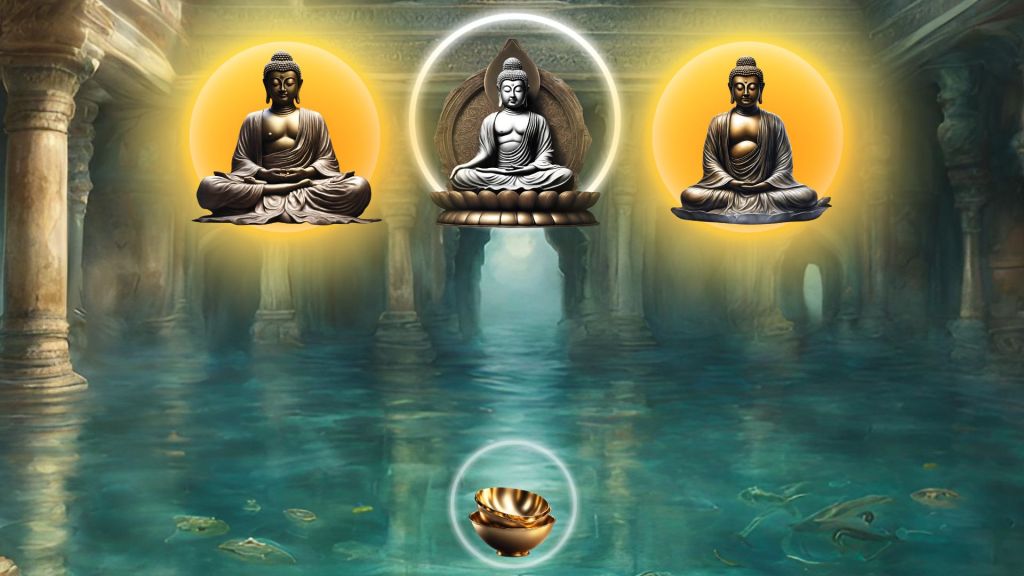
There, the golden cup collided with the vessels of past Buddhas, emitting a resounding metallic sound. It found its place beneath the other cups of Buddha Kakusandha, Koṇāgamana, and Kassapa, symbolizing Siddhartha’s path to join their ranks.
After washing up, Siddhartha spent the day engaging in breathing meditation. He swiftly unlocked profound states of Jhana and attained the five super-knowledges, or abhiññā, also known as super powers.
These superpowers endowed Siddhartha with extraordinary abilities.
- He could manipulate the elements at will, walking on water as if it were land or traversing through walls as effortlessly as through air.
- Furthermore, he developed divine ears
- and eyes, enabling him to perceive distant sights and sounds transcending the realms of existence.
- Additionally, Siddhartha acquired the ability to read minds
- and recollect his past lives.
Note: Until here, it is not enlightenment yet. Such knowledge or powers are common outside of Buddhism too.
With his mental training for the day complete, Siddhartha refreshed himself with a dip in the river. Emerging from his bath, he encountered Sotthiya, a Brahmin grass-cutter, who offered him eight handfuls of grass. Siddhartha, carrying the grass, ascended to a high ground beneath the majestic Bodhi tree, where he fashioned a meditation seat facing east.
Note: It is interesting to note that Siddhartha before enlightenment, was also steep in following traditional lores. For example, the interpretation of dreams, asking for a sign before a major quest, and facing an auspicious direction (In India Vastu, the east symbolise renewal and fresh start, life, etc) But after enlightenment, Shakyamuni Buddha had taught that these are lowly arts and instructed his disciples not to indulge in them.
With the Bodhi tree as his backdrop, Siddhartha made a solemn declaration. He vowed to remain seated until he attained Buddhahood, even if it meant his body withering away entirely, leaving only skin, sinews, and bones.
Note: This is the verbalization of a mental conviction. It conveyed a deep sense of unwavering determination. It is important to know that Siddhartha did not have self-malice or ill-will. It is not a commitment to disregard self-care. In simple terms, in our modern language, it could translate as “I shall not give up no matter what”
As Siddhartha settled into his meditation seat, divine beings from various heavens gathered to witness this monumental moment. However, as Siddhartha’s enlightenment drew near, Vasavatti Mara marshaled his armies from the realm of Vasavatti heaven.
Transforming into terrifying forms, Mara’s forces surged towards Siddhartha with weapons drawn. Sensing the impending threat, the celestial beings fled in fear, leaving Siddhartha alone beneath the Bodhi tree. Undeterred by Mara’s formidable army, Siddhartha remained seated, his resolve unshaken. Mara found himself unable to enter the immediate vicinity of the Bodhi tree, forced to encircle the area with his vast forces.
Surveying the scene, the lonely Siddhartha remained steadfast, drawing strength from the virtues he had perfected over countless lifetimes. With unwavering determination, he prepared to confront Mara’s forces, relying solely on the merits of his perfected virtues.
Unable to directly confront Bodhisattva Siddhartha, Mara and his army resorted to launching a relentless assault by hurling a barrage of missiles – stones, burning coals, sharp weapons, water, fire, and more. Yet, as these weapons approached Siddhartha, they transformed into flowers and pleasant offerings.
Frustrated by his failed attacks, Mara conjured illusions of terrifying scenes and monstrous forms, attempting to shroud the world in darkness. But Siddhartha, emanating a network of light rays, effortlessly dispelled these illusions.
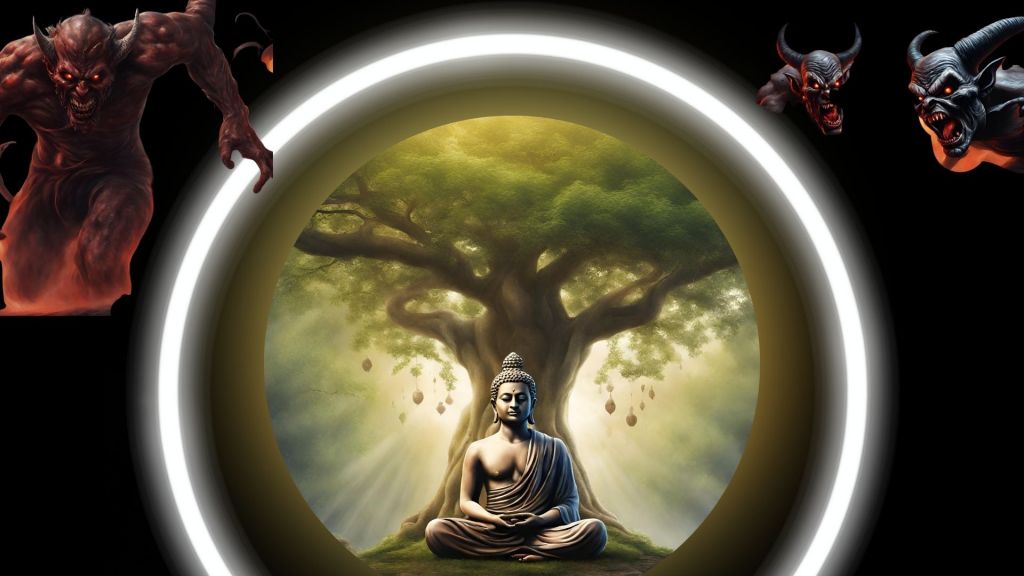
Throughout Mara’s onslaught, Siddhartha maintained unwavering compassion towards him, likening Mara’s actions to those of a misbehaving child lost in ignorance and tantrums. Siddhartha then admonished Mara for his egoism, warning him of the dire consequences of his actions.
Siddhartha: Mara, why are you doing this? Do you know that your actions bear heavy consequences? When your merit is exhausted, the lower realms will be your next destination.
Mara: I am doing this because you are occupying my seat. Leave your seat, and I will stop.
Siddhartha: Mara, you claim this seat is yours. Who is your witness?
Mara: My entire army is my witness. (Jeering and clamoring)
Siddhartha: Your witnesses are not reliable and biased. But my witness is impartial to all as it is inanimate. This seat of enlightenment belongs to one who has perfected their virtues and I have perfected the virtues of enlightenment.
Touching the ground, Siddhartha invoked the earth to attest to his accumulation of perfections. In an instant, thunderous sounds echoed through the sky and mountains.
Mara and his armies misinterpreted the frightful sound as a sign of impending catastrophe and fled in fear.
Without a second thought, Mara fled the scene along with his army.
With Mara’s forces in retreat, Siddhartha emerged victorious before sunset on the full moon day of May (Vesākha), in the year 528 BCE (Before the Common Era). In that manner, he became the conqueror of the entire realm of sentient beings, attaining a state free from harm, danger, and fear.
Note: All the gods and goddesses had fled when Mara arrived, and since Buddha defeated Mara. Buddha became the conqueror of all. At this point in time, it was not enlightenment yet.
It is important to note that Buddha defeated negativities with his perfected virtues. In that manner, the term conqueror shouldn’t be associated with power, violence, war, domination, etc. ( a great exercise for profound reflection and contemplation)
Note: The state of a fearless mind, free from doubt and uncertainty; is important for attaining realization. One must be free from doubt, hesitations, negativities, etc. This is why, certain schools of Buddhism teach their practitioners to develop a very strong faith in their Guru or the Triple Gems. If we practice what we were taught with doubts troubling our minds, it is very hard for our minds to commit and dive right in.
As Siddhartha sat in meditation, his mind pure, bright, and fearless, he inclined it towards attaining supreme knowledge. In successive stages throughout the night, he acquired the three realizations.
In the early part first watch of the night, Siddhartha recalled and gained insight into all his past existences and realized that there is no inherent existence of a ‘self’.
Just before midnight, he gained the ability to know the past lives of all beings and the causes that shape their journey through death and rebirth.
Finally, on that night, Siddhartha gained the knowledge of the extinction of impurities, putting an end to the endless cycle of rebirth in samsara. This marks the third and final realization.
And so, after gaining the third realization on the May full moon night, Bodhisattva Siddhartha attained enlightenment to become a Buddha, illuminating the world with his enlightened wisdom and qualities and ushering in an era of profound wisdom and compassion.
May all be well and happy.
Discussions
- The importance of support by others: Siddhartha’s journey toward final enlightenment was marked by the encounter with 2 lay people. Discuss the significance and importance of support from society in the quest for enlightenment.
- Do you think the characters of one male and one female have any hidden messages? While Sujata was a maternal housewife rich in resources, Sotthiya was a manual worker from a reputable caste (Brahmin). Ultimately, Siddhartha kept the grass and discarded the gold bowl. Is there a deeper meaning to it?
Categories: Articles, Shakyamuni Buddha
 I am just an ordinary guy in Singapore with a passion for Buddhism and I hope to share this passion with the community out there, across the world.


 Bodhi-Bowl